Canker Sore vs Oral Cancer: How to Tell the Difference
Most people get a canker sore at some point and never think twice. But when a mouth sore lingers longer than expected, a troubling question can surface: could this be something more serious? The good news is that canker sores and oral cancer look and feel different in ways that trained eyes can spot. This guide walks through the visual clues, pain patterns, and red flags that cancer centers like MD Anderson and Roswell Park want you to know — so you can tell the difference and understand when to seek care.
Quick snapshot
- Canker sores have red, inflamed borders (UT MD Anderson Cancer Center)
- Oral cancer edges are typically not red or inflamed (UT MD Anderson Cancer Center)
- Early oral cancer is often painless (UT MD Anderson Cancer Center)
- Whether specific warning signs manifest differently across populations
- Exact prevalence of trismus (difficulty opening mouth) in oral cancer patients
- A sore lasting beyond 2 weeks without healing warrants evaluation (Roswell Park Comprehensive Cancer Center)
- If a mouth sore persists past 2–3 weeks, a dentist or physician can perform a biopsy to rule out cancer (Dr. Hart’s Office)
Canker sore typical appearance: small, round, white/yellow center with red border · Oral cancer edge appearance: not usually red or inflamed · Canker sore pain level: usually painful · Early oral cancer pain: often painless · Canker sore healing time: shrinks and heals
Canker sores and oral cancer differ across nine measurable attributes—from shape and color to healing behavior and bleeding tendency. The comparison below distills what MD Anderson, Roswell Park, and other major cancer centers have documented about these two conditions.
| Attribute | Canker Sore | Oral Cancer |
|---|---|---|
| Shape | Round, uniform | Varied, irregular |
| Color | White or yellow center, red border | Red or white patches, or mottled appearance |
| Border appearance | Red and inflamed | Not typically red or inflamed |
| Texture | Flat and smooth | Rough, raised, hardened, or with palpable lump underneath |
| Pain level | Usually painful, especially while eating or talking | Often painless in early stages |
| Healing behavior | Shrinks and heals within 1–2 weeks | Persists beyond 2 weeks without healing |
| Most common location | Inner cheeks, lips, under tongue | Tongue (most common), also lips, gums, cheek, hard palate, floor of mouth |
| Bleeding tendency | Rare | More likely with unexplained bleeding |
| Contagiousness | Not contagious | Not contagious (not spread person-to-person) |
How to tell if it’s a canker sore or cancer?
At first glance, a canker sore and an early oral cancer lesion might look similar. Both can appear as small sores inside the mouth. But several visual and sensory clues help distinguish one from the other, and knowing what to look for can make a meaningful difference in early detection.
Appearance differences
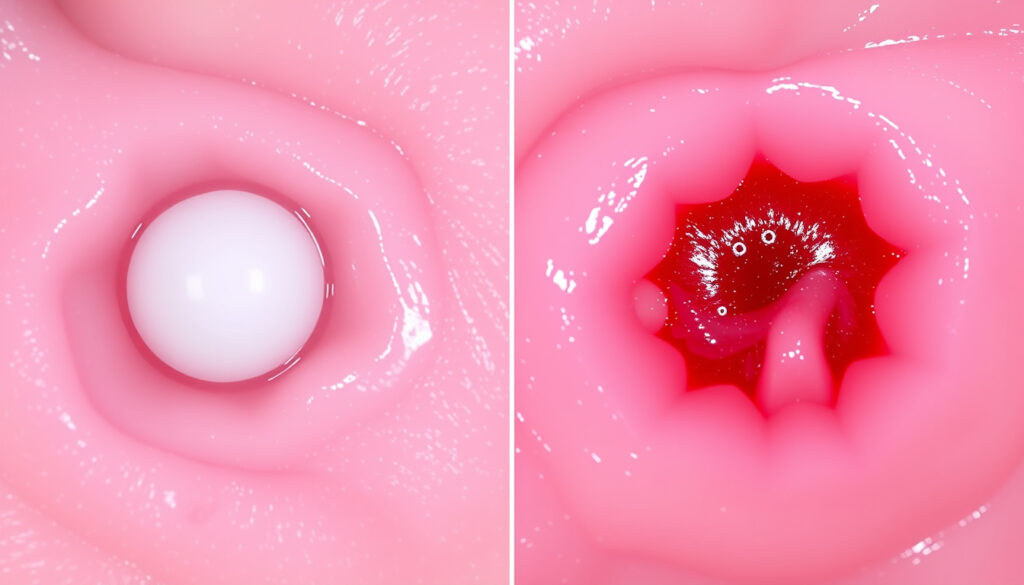
Canker sores typically present as small, round ulcers with a white or yellowish center surrounded by a red, inflamed border. The edges are often “red and angry looking because the surrounding tissue is inflamed,” according to UT MD Anderson Cancer Center, a leading cancer treatment and research institution. This redness signals the body’s inflammatory response actively working to heal the area.
Oral cancer lesions, by contrast, often appear without that inflamed border. They may show up as flat red or white patches, lumps, or ulcers with a mottled texture. Dr. Vishal Gupta, a head and neck surgeon at Roswell Park Comprehensive Cancer Center, notes that oral cancer lesions “can differ” from the neat, round appearance of canker sores. The edges of a cancer lesion typically lack the angry red appearance that characterizes inflamed canker sore borders.
Canker sore edges are red and inflamed because surrounding tissue is responding to irritation. Oral cancer lesions usually lack that inflamed border — which is itself a warning sign that something is not healing normally.
Pain and duration
Pain provides one of the most reliable differentiating factors. Canker sores are usually painful, particularly when eating, drinking, or talking. The pain is sharp and immediate because the lesion sits on sensitive nerve-rich tissue.
Early oral cancer is frequently painless. “Unlike canker sores, oral cancer usually does not cause sharp pain,” notes Healthline, a medically reviewed health information platform. Dr. Gupta of Roswell Park observes that “many people with mouth cancer may not experience pain at all.” This absence of pain in the presence of a persistent mouth lesion is precisely why regular dental checkups matter.
Duration tells the story over time. A canker sore typically heals within 1–2 weeks without treatment, gradually shrinking as it resolves. An oral cancer lesion does not follow this pattern — symptoms “tend to linger, change, or grow over time,” according to Dr. Hart’s Office, a dental practice providing patient education on oral lesions. A sore that persists beyond 2 weeks without improvement is the most reliable single indicator to seek professional evaluation.
When to seek medical help
The threshold is clear: any mouth sore that lasts longer than two weeks without signs of healing warrants professional evaluation. Healthcare professionals recommend seeking care if a sore persists for more than two weeks, according to Roswell Park Comprehensive Cancer Center. Additional warning signs include fever or swollen lymph nodes accompanying the mouth sore, unexplained bleeding, numbness, or difficulty swallowing.
A canker sore that bleeds when accidentally bitten is normal. Unexplained bleeding from a mouth sore with no clear cause — especially if it persists — is not normal and should prompt a visit to a dentist or physician.
The implication: patients often dismiss a painless, persistent sore as “just another canker sore” because it doesn’t hurt. That pain-free quality is precisely what makes early oral cancer insidious. If a lesion in your mouth is not healing after two weeks, see a professional — pain is not required for something to be serious.
“The edges of a canker sore are often red and angry looking because the surrounding tissue is inflamed. That’s not usually the case with cancers.”
— UT MD Anderson Cancer Center
What does stage 1 mouth cancer look like?
Stage 1 oral cancer represents a tumor that measures less than 2 centimeters at its widest point and has not spread to nearby lymph nodes or distant organs. Recognizing what this early-stage cancer looks like helps patients identify problems before they advance.
Visual characteristics
Stage 1 oral cancer does not have a single characteristic appearance. It may manifest as a small red patch (erythroplakia), a white patch (leukoplakia), a tiny ulcer that refuses to heal, or a subtle lump beneath the surface. Unlike a canker sore’s uniform round shape, early oral cancer lesions are often irregular in form. They may bleed when touched lightly or when brushing teeth.
A key physical finding is texture. While canker sores feel flat and smooth, oral cancer lesions are often “rough, raised, hardened, or with palpable lump underneath,” according to Everhope Dental, a dental practice providing patient education on oral conditions. UT MD Anderson Cancer Center confirms that oral cancer lesions often have “a tiny lump or bump underneath that can be felt, unlike flat canker sores.”
Common locations
Oral cancer can develop on the tongue, lips, gums, cheek, hard palate, or floor of the mouth, according to UT MD Anderson Cancer Center. Canker sores most commonly occur on inner cheeks or lips, while oral cancer most commonly develops on the tongue, according to Healthline.
When oral cancer spreads to lymph nodes in the neck, it may cause swelling or lumps there — even before the primary mouth lesion becomes obvious. Oral cancer that invades muscles controlling the jaw can make it difficult to open and close the mouth, a condition called trismus, according to Cancer Therapy Advisor.
What are the 7 warning signs of mouth cancer?
While no definitive “seven signs” list appears uniformly across authoritative sources, major cancer centers consistently identify a cluster of symptoms that warrant evaluation. Understanding these warning signs helps patients know when to move beyond self-monitoring.
Key symptoms list
Common oral cancer symptoms include persistent mouth sores that do not heal, thickening of the mouth or throat tissue, difficulty swallowing and chewing, changes in voice, and unexplained weight loss, according to Roswell Park Comprehensive Cancer Center. Additional warning signs include:
- Red or white patches inside the mouth that cannot be scraped off
- Lumps or rough areas that persist or grow
- Unexplained bleeding in the mouth
- Numbness in the lips or mouth without cause
- Difficulty chewing, swallowing, or moving the jaw
- Persistent jaw or tongue discomfort
- A sore that persists beyond 2 weeks without healing
Smoking tobacco and drinking alcohol are major risk factors for oral cancer, while stress and immunosuppression are risk factors for canker sores, according to Healthline. Patients with these risk factors should be especially vigilant about any mouth changes. Cleveland Clinic emphasizes that cancerous lesions usually do not hurt initially — a critical distinction from painful canker sores.
“Canker sores are typically smaller and round, with a white or yellowish center and red border. Oral cancer lesions can differ.”
— Dr. Vishal Gupta, Roswell Park Comprehensive Cancer Center
The implication: the absence of pain does not equal absence of danger. If you have one or more risk factors and notice any persistent mouth change — even without pain — a dental or medical evaluation is the right move.
What is the 3 finger test for oral cancer?
The “three finger test” is a simple self-screening method used to check for trismus, a condition where jaw opening becomes restricted. It is not a diagnostic tool for cancer itself, but it can flag one potential consequence of oral cancer that has invaded jaw muscles.
How to perform
To perform the test, place three fingers — stacked vertically — between your upper and lower teeth. A normal mouth opening should comfortably accommodate three fingers side-by-side. If you cannot fit three fingers between your teeth, this indicates restricted jaw opening, which may suggest trismus.
What it indicates
Trismus occurs when oral cancer invades the muscles that control jaw movement, making it difficult to open and close the mouth, according to Cancer Therapy Advisor. This symptom can also result from other conditions such as temporomandibular joint disorders, trauma, or dental infections. However, if a patient with other oral cancer risk factors or symptoms develops new difficulty opening their mouth fully, this warrants professional evaluation.
The three finger test is a screening aid — not a diagnosis. A dental or medical professional can perform a more thorough examination and recommend imaging or biopsy if needed. Early-stage oral cancer that has not yet invaded jaw muscles will not cause trismus, so a normal mouth opening does not rule out cancer.
The catch: the three finger test only detects trismus — a late-stage symptom that appears after cancer has invaded jaw muscles. By the time this sign appears, the cancer has typically progressed beyond stage 1. This underscores why earlier screening — when lesions are still small, painless, and localized — offers the best outcomes.
Oral cancer symptoms by stage
Oral cancer symptoms evolve as the disease progresses. Understanding how symptoms change from early to advanced stages helps patients appreciate why early detection matters and what signs indicate advancement.
Early vs advanced stages
In early stages (1–2), oral cancer typically presents as a small, persistent sore, patch, or lump that may or may not be painful. The tumor remains localized and has not spread to lymph nodes. Key characteristics at this stage include the lesion persisting beyond 2 weeks without healing, a texture that feels rough or raised rather than smooth, and potential bleeding with minimal irritation.
As cancer advances to stages 3–4, the lesion grows and may ulcerate. Difficulty swallowing (dysphagia) and chewing become more pronounced. When oral cancer spreads to lymph nodes, it may cause swelling or lumps in the neck, according to Cancer Therapy Advisor. The cancer may invade surrounding tissues including jaw muscles (causing trismus), nerves (causing numbness), and voice structures (causing hoarseness or voice changes).
Oral cancer can spread to other tissues such as the lungs, causing shortness of breath and chest pain if metastasized, according to Healthline. This is why early detection — before the cancer spreads beyond the mouth — offers the most favorable prognosis. Stage 1 oral cancer confined to the original site has a significantly higher survival rate than advanced-stage disease with lymph node or distant spread.
The implication: a mouth sore that feels fine but keeps changing or growing is more concerning than a painful sore that starts shrinking. By the time symptoms like neck lumps, voice changes, or jaw stiffness appear, the cancer has typically advanced. Regular dental exams catch these lesions early — when they’re still small and before symptoms develop.
Related reading: Signs of Skin Cancer
brennandentalaz.com, brookwooddentistry.net, worcesterdentalimplants.com, sunrisedentalservice.com, mdanderson.org
While canker sore symptoms on tongue usually present as round white ulcers with red edges that heal in weeks, persistent lesions may signal oral cancer.
Frequently asked questions
Are canker sores cancerous?
No. Canker sores (aphthous ulcers) are benign lesions that are not cancerous and do not spread. They are not contagious. Canker sores are caused by stress, minor tissue injuries, certain foods, or immunosuppression — not by cancer or precancerous changes. However, a mouth sore that resembles a canker sore but persists beyond two weeks without healing should be evaluated by a professional to rule out oral cancer.
How long does a canker sore last?
Most canker sores heal within 1–2 weeks without treatment, gradually shrinking as they resolve. They typically disappear completely within two weeks. A sore that remains after two weeks may not be a canker sore and warrants professional evaluation.
Can canker sores bleed?
Canker sores can bleed if they are irritated — for example, if you accidentally bite them or brush them aggressively. Minor bleeding from a canker sore is not unusual and does not by itself indicate cancer. Unexplained bleeding from a mouth sore with no clear trigger, especially if persistent, should be evaluated by a healthcare provider.
What causes painless canker sores?
The term “painless canker sore” is somewhat misleading. While minor canker sores may cause only mild discomfort, most canker sores are painful — particularly when eating, drinking, or talking. The pain comes from the lesion sitting on sensitive oral tissue. If you have a mouth sore that is completely painless and persists beyond two weeks, it may be an oral cancer lesion rather than a canker sore, and you should seek evaluation.
Is a mouth ulcer the same as a canker sore?
Yes, in most contexts “mouth ulcer” and “canker sore” refer to the same thing — a benign ulcer that forms inside the mouth. Both terms describe a round, painful lesion with a white or yellowish center and red border. However, the word “ulcer” can also describe cancerous lesions, which is why precise terminology matters when discussing mouth health with a provider.
When does a mouth sore need a biopsy?
A biopsy is typically recommended when a mouth sore persists beyond 2–3 weeks without healing, has an irregular or unusual appearance, shows signs of texture changes (roughness, hardening, palpable lump underneath), or exhibits unexplained bleeding. Dentists and oral surgeons perform biopsies in these situations to definitively rule out oral cancer. The procedure is minor and usually requires only local anesthesia.
Do canker sores turn into cancer?
No. A true canker sore is a benign oral lesion and does not transform into cancer. However, it is possible to dismiss an early oral cancer lesion as “just a canker sore” if it is painless or looks similar to a canker sore. This is why the healing timeline matters: a genuine canker sore resolves within 1–2 weeks. A lesion that persists, changes, or grows after two weeks is not a canker sore, regardless of how it looks, and requires professional evaluation.
More related posts
 The Legend of Zelda – Games in Order and Timeline Guide
 Signs of Blood Clot in Leg: Early Symptoms & ER Guide
 Millie Bobby Brown Wedding: Date, Dress, Noah & Details
 Maid of the Mist: Niagara Boat Tour Guide, Tickets & Tips
 How Long Does Chicken Last in the Fridge? A Complete Guide
 Galaxy A02s to Buy: Worth It? Prices, Reviews 2024
 Happy Gilmore 2 Cast: Full List of Actors and Cameos
 We Were Liars Book: Complete Guide to the Series & Twist