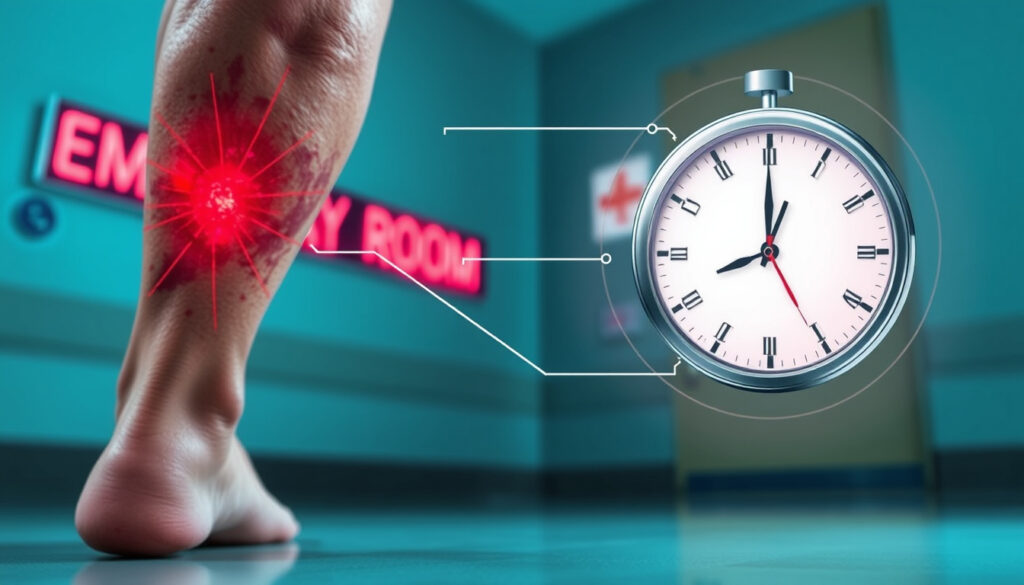
Signs of Blood Clot in Leg: Early Symptoms & ER Guide
You twist your leg getting out of bed and the calf muscle pulls — or so you think. But when the ache doesn’t fade and the leg starts looking puffy, the question hits differently: could this be a blood clot? Recognizing the early signs of a blood clot in your leg can be the difference between a straightforward treatment and a life-threatening emergency. We’ll walk through the symptoms that matter, simple self-check methods, and the exact moment you should stop Googling and head to the ER.
Annual DVT cases in the US: 900,000 (CDC) ·
Undiagnosed asymptomatic DVT: 40–50% in some studies ·
Risk of fatal PE if untreated: 1 in 10
Quick snapshot
- Swelling in one leg (NHS (UK health authority))
- Pain, tenderness or cramp (Mayo Clinic (leading US medical center))
- Warmth and redness (NHS (UK health authority))
- Bluish or reddish skin discoloration (NHS (UK health authority))
- Compare both legs for size/color changes (Mayo Clinic)
- Feel for warmth with back of hand (NHS)
- Gently squeeze calf (note deep pain) (WebMD (health information provider))
- Check for skin sores or tightness (WebMD)
- Sudden severe leg pain and swelling (NHS)
- Chest pain or trouble breathing (Sherwood Forest Hospitals NHS Trust)
- Coughing up blood (Sherwood Forest Hospitals NHS Trust)
- Rapid heart rate or lightheadedness (NHS)
- Exact prevalence of asymptomatic DVT (Mayo Clinic)
- Home squeeze test sensitivity not validated (WebMD)
- Optimal anticoagulation duration in all cases (NHS)
| Metric | Value |
|---|---|
| Annual US DVT cases | 900,000 (CDC (US public health agency)) |
| DVT leading to PE | Approximately 100,000 deaths/year (CDC) |
| Asymptomatic DVT proportion | Up to 50% may have no symptoms (Mayo Clinic) |
| Standard treatment duration | 3–6 months anticoagulation (NHS) |
The pattern: DVT is common, often silent, and deadly when ignored — but highly treatable with timely care.
What are the first signs of a leg blood clot?
Deep vein thrombosis rarely announces itself with a fanfare. The signs of deep vein thrombosis in leg often start subtly — a dull ache behind the knee, a slight puffiness that you notice only when comparing legs in the mirror. But a handful of hallmark symptoms, backed by major health authorities, should get your attention.
Common early symptoms
- Swelling in one leg, usually the calf or thigh, that does not go down with elevation (NHS (UK health authority))
- Throbbing pain or tenderness in one leg, rarely in both, often starting in the calf (NHS)
- Warmth over the affected area, best felt by comparing both legs with the back of the hand (East Lancashire Hospitals NHS Trust)
- Skin color changes — red, bluish, or darkened skin; harder to spot on brown or black skin (NHS)
- Tight or shiny skin over the leg, sometimes accompanied by visibly swollen veins (WebMD (health information provider))
When symptoms appear
In many cases the early signs of DVT emerge gradually — over hours or days — after a period of immobility: a long-haul flight, a hospital stay, or wearing a leg cast. University Hospitals of Derby and Burton NHS Foundation Trust notes that new or worsening leg pain that does not settle with painkillers after lower-limb immobilization should prompt a DVT check. However, DVT can also occur without any identifiable trigger — and up to 50% of cases may have no noticeable symptoms at all (Mayo Clinic (leading US medical center)).
Because DVT can be silent, anyone waiting for a clear symptom — like dramatic swelling — risks missing the window. The NHS recommends seeking medical advice for even mild one-sided leg symptoms that last more than a few hours.
Subtle signs
- Pain that worsens when you stand or walk but eases when you lie down (WebMD)
- Cramping sensation that feels like a charley horse but persists beyond a few minutes (Mayo Clinic)
- Mild swelling that you notice only when your shoe feels tighter on one foot (Chelsea and Westminster Hospital NHS Foundation Trust)
How do you test for a blood clot in your leg at home?
Let’s be direct about this: there is no DIY test that can confirm or rule out a DVT. But you can do a structured self-check that gives you — and your doctor — useful information. The home examination below is based on observation methods recommended by NHS (UK health authority) and Mayo Clinic, not a diagnostic tool.
Visual inspection
Stand bare-legged in front of a mirror. Look for these four markers, comparing one leg to the other:
- Swelling: does one calf or ankle look noticeably fuller?
- Color: any redness, bluish tinge, or darker patch that the other leg lacks?
- Vein prominence: are veins on one leg more visible or bulging?
- Skin texture: does the skin on one calf look tight or shiny?
Squeeze test
This is an informal maneuver — not validated in large trials — used by some clinicians as a screening clue. Gently squeeze your calf with your fingers. If you feel deep, disproportionate pain compared with the other leg, it could indicate inflammation from a clot. WebMD (health information provider) mentions the squeeze test in its symptom discussion, but emphasizes that a negative squeeze test does not rule out DVT. Do not press hard — you risk dislodging a clot.
When to see a doctor
If your visual check or squeeze test raises any suspicion, the guidance from NHS is unequivocal: call 111 (UK) or your primary care provider the same day. Do not wait to see if the symptom resolves overnight. Doctors diagnose DVT using a combination of D-dimer blood test and ultrasound, which are the only reliable methods (Mayo Clinic).
The home squeeze test has not been validated in large clinical trials. Relying on a negative squeeze test could give false reassurance — and that delay can be fatal. If you suspect DVT, the only safe step is professional medical evaluation.
The trade-off: the squeeze test and visual check may help you decide whether to call a doctor, but they cannot confirm a clot. For patients in the US, the Centers for Disease Control and Prevention (CDC (US public health agency)) advises seeking emergency care if you have sudden leg swelling and chest pain combined.
What can be mistaken for a blood clot in the leg?
One of the trickiest things about DVT: several conditions look almost identical. Misdiagnosis runs in both directions — people with harmless muscle cramps rush to the ER, while real clots get dismissed as “just a pulled muscle.” Here is how they compare.
Five common mimics, one key pattern: DVT pain does not fade with rest and usually involves swelling.
| Condition | How it mimics DVT | Key difference |
|---|---|---|
| Muscle strain or charley horse | Sudden calf pain, tenderness | Resolves with rest/stretching; no swelling or warmth (WebMD) |
| Cellulitis | Red, warm, swollen leg | Skin is hot, red, and tender; usually has a fever; no one-sided pain pattern (Mayo Clinic) |
| Varicose veins | Swollen, bulging veins, mild ache | Pain is dull, chronic; swelling usually bilateral or symmetric; no redness (NHS) |
| Lymphedema | Leg swelling, heaviness | Swelling is pitting and diffuse; no localized warmth or color change (Chelsea and Westminster Hospital NHS Trust) |
| Baker’s cyst | Swelling and pain behind the knee | Pain is sharp when bending knee; swelling is localized to the popliteal space; no whole-leg warmth (NHS) |
The pattern: even experienced clinicians cannot reliably distinguish these conditions without imaging. Let an ultrasound decide.
Why this matters: a Baker’s cyst can actually rupture and mimic DVT so closely that some patients end up on anticoagulants before ultrasound reveals the truth. The safest approach is to let imaging decide — your eyes and fingers cannot reliably tell the difference.
Can a leg blood clot clear on its own?
Yes and no. Small distal clots — those below the knee — can dissolve spontaneously without treatment in some cases. But relying on natural resolution is dangerous because there is no way to predict which clot will grow, break off, and travel to the lungs.
Natural resolution
The NHS (UK health authority) notes that the body’s own fibrinolytic system can break down small thrombi over weeks. However, even small clots that resolve on their own can damage the vein valves, leading to post-thrombotic syndrome — chronic leg pain and swelling.
Risks of untreated DVT
- Clot growth: a small calf DVT can extend into the thigh within days (Mayo Clinic)
- Pulmonary embolism (PE): when a clot breaks loose and lodges in the lung arteries — fatal in about 1 in 10 untreated cases (CDC)
- Post-thrombotic syndrome: chronic pain, swelling, and skin ulcers in the affected leg (NHS)
- Recurrence: untreated DVT increases the risk of a second clot by 3- to 5-fold
The pattern is stark: the CDC (US public health agency) estimates that 100,000 Americans die each year from PE related to DVT — and most of those deaths are preventable with timely anticoagulation. Standard treatment with blood thinners for 3 to 6 months reduces the mortality risk to near zero.
The implication: hoping a clot resolves on its own is a gamble with a 10% fatality rate. Treatment is safe and effective; delay is not.
How to prevent blood clots in legs?
Prevention is less about pills and more about habits. For anyone who has had a clot — or has risk factors like obesity, cancer, or recent surgery — the difference between a healthy recovery and a hospital readmission often comes down to a few daily actions.
Movement and exercise
Your calf muscles act as a natural pump that pushes blood back toward the heart. When you sit still for hours — on a plane, at a desk, during a long car ride — that pump shuts off. The NHS (UK health authority) recommends these simple moves:
- Every hour, stand and walk for 2 minutes
- While seated, pump your feet up and down (calf pumps) for 30 seconds each hour
- On flights longer than 4 hours, walk the aisle once per hour
- After surgery, follow the physiotherapist’s mobilization plan — even short walks reduce risk
Hydration
Dehydration thickens the blood, making clots more likely. The NHS advises drinking enough water (6-8 glasses per day) and avoiding alcohol on long trips, as alcohol dehydrates.
Compression stockings
Graduated compression stockings apply gentle pressure that helps blood flow upward. They are recommended for:
- Long-haul flights (over 4 hours) for people with additional risk factors (Mayo Clinic)
- Post-surgical recovery, especially hip or knee replacement
- Pregnant women with a history of DVT
Lifestyle factors
- Smoking cessation: smoking damages the lining of blood vessels and thickens blood. Quitting halves your clot risk within 1 year
- Weight management: obesity increases pressure on leg veins and reduces mobility — maintain a BMI under 30 when possible (CDC)
- Leg elevation: when resting, keep legs raised above hip level to aid venous return
The implication for anyone planning a long trip or recovering from surgery: the single most effective prevention move costs nothing but 2 minutes of walking each hour. For patients in the US, the CDC emphasizes that hospital-acquired DVT is largely preventable with early ambulation and mechanical prophylaxis.
The takeaway: these habits work because they target the root cause — blood stasis. Move, hydrate, and compress, and you dramatically cut your risk.
“Deep vein thrombosis in the leg commonly causes swelling in one leg — usually the calf or thigh — along with throbbing pain, warm skin, and a reddish or bluish discoloration. If you notice any of these signs, seek medical attention promptly.”
NHS (UK health authority)
“Leg swelling, leg pain or cramping that often starts in the calf, skin color change, and warmth are hallmark symptoms of DVT. The condition can occur without noticeable symptoms, so people with risk factors should remain vigilant.”
Mayo Clinic (leading US medical center)
“Swelling, leg pain or tenderness, reddish or bluish skin discoloration — these are the signs to watch for. If you experience sudden chest pain or difficulty breathing, call 911 immediately.”
“New increased leg pain that is getting worse or not settling with painkillers can be a warning sign of DVT. Unexplained swelling in the injured leg and warm or discolored skin should also prompt a medical check.”
University Hospitals of Derby and Burton NHS Foundation Trust
veinreliever.com, salcedomedicalcenter.com, int.livhospital.com, dbth.nhs.uk, uhsussex.nhs.uk
For a comprehensive overview of what to watch for, review the early warning signs of DVT that medical professionals recommend checking.
Frequently asked questions
What is deep vein thrombosis (DVT)?
Deep vein thrombosis is a blood clot that forms in a deep vein, most commonly in the lower leg, thigh, or pelvis. It can partially or completely block blood flow and may lead to a life-threatening pulmonary embolism if the clot breaks loose (NHS).
Who is at risk for developing a blood clot in the leg?
Risk factors include prolonged immobility (long flights, bed rest), recent surgery or trauma, cancer, obesity, smoking, pregnancy, oral contraceptives, hormone therapy, and inherited clotting disorders (CDC).
How long does it take for a blood clot to form?
DVT can develop within hours of immobility. After major surgery or trauma, the highest risk period is the first 2 weeks, though the risk remains elevated for up to 3 months (Mayo Clinic).
Can DVT occur in both legs?
It is rare but possible. Bilateral DVT is usually seen in patients with extensive clotting disorders or prolonged immobilization affecting both limbs. In most cases, DVT affects only one leg (Chelsea and Westminster Hospital NHS Trust).
How is DVT diagnosed by a doctor?
Diagnosis typically involves a D-dimer blood test (elevated levels suggest clot formation) and a compression ultrasound, which can directly visualize the clot in the vein. In ambiguous cases, venography or CT venography may be used (Mayo Clinic).
What is a pulmonary embolism?
A pulmonary embolism occurs when a blood clot from the leg travels through the bloodstream and lodges in an artery in the lung. It can cause sudden shortness of breath, chest pain, coughing up blood, and collapse. PE is fatal in about 1 in 10 untreated cases (CDC).
Can I travel with a DVT or after treatment?
If you are currently on anticoagulation for DVT, short-distance travel is generally safe. For long flights (over 4 hours), consult your doctor. After completing treatment, most people can travel normally, but wear compression stockings and follow movement guidelines during the flight (NHS).
Should I wear compression socks to prevent DVT?
Compression stockings are recommended for people at high risk: during long-haul flights, after surgery, or for pregnant women with prior DVT history. They should be fitted properly — too-tight stockings can actually impede circulation (Mayo Clinic).
Related reading
- Symptoms of High Blood Pressure: Warning Signs and How to Lower It
- What Does the Liver Do? Functions and Damage Signs
Recognizing the signs of blood clot in leg early — and acting on them — is the single most effective way to prevent catastrophic outcomes. For anyone with risk factors, the choice is clear: learn the symptoms, perform regular self-checks after long travel or surgery, and seek medical evaluation at the first sign of one-sided leg swelling or pain. The alternative — waiting to see if it resolves — carries a 1-in-10 chance of fatal pulmonary embolism, a risk no one should take.
More related posts
 André Filipe Teixeira da Silva: Life, Career, and Tragic Death
 Types of Love Language: The 5, 7, and 8 Models Explained
 How to Use a Rice Cooker: Step-by-Step Guide & Water Ratios
 Sarah Michelle Gellar Movies and TV Shows Complete Guide
 From Season 4 Release Date: Premiere, Schedule & How to Watch
 Christopher Nolan’s The Odyssey Trailer: Plot, Cast, Release
 Salary to Hourly Calculator Ireland: Formulas & Taxes
 The Chosen Season 1: Watch, Controversy & Accuracy