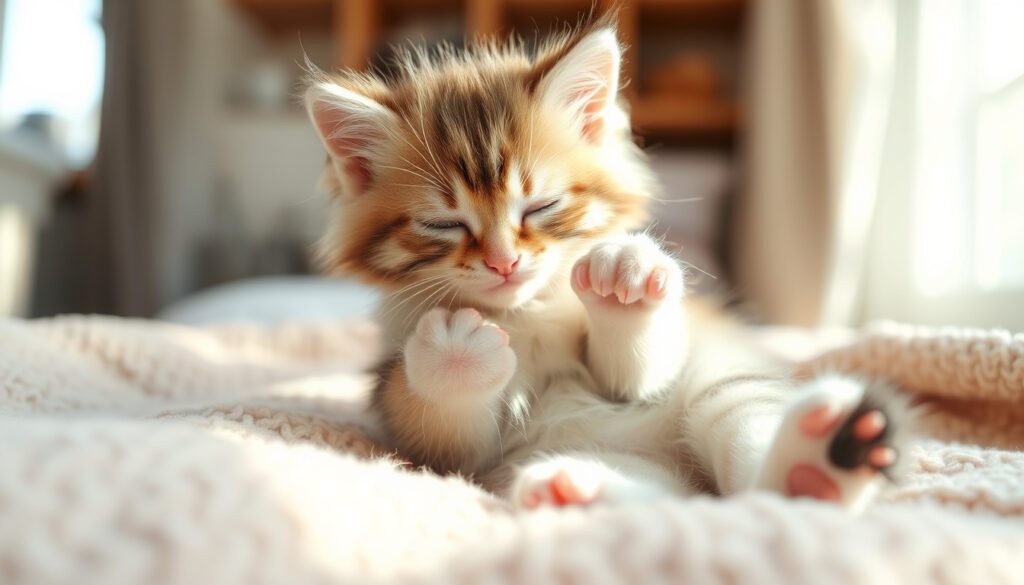
Why Do Cats Make Biscuits? Kitten Instincts and Affection Signs
If you’ve ever been on the receiving end of that rhythmic paw-push — claws catching on skin, a steady push-and-pull that looks suspiciously like kneading dough — you already know how weirdly hypnotic it is. The behavior is old, instinctive, and packed with meaning that most cat owners never stop to think about.
Origin: Kitten nursing stimulation · Scent Marking: Pheromones from toe glands · Emotional Signal: Contentment and relaxation · Evolutionary Link: Milk let-down association
Quick snapshot
- Kneading originates from kitten nursing, when pressing the mammary chain stimulates oxytocin release and milk flow (VCA Hospitals)
- Scent glands in paw pads deposit pheromones that mark territory and communicate with other cats (COAPE)
- The exact neurochemical pathways involved in kneading have not been definitively mapped in cats (Figo Pet Insurance)
- Regional or breed-specific variations in kneading frequency lack quantitative study (Figo Pet Insurance)
- Understanding kneading helps owners respond appropriately — whether that means gentle petting or keeping a blanket between claws and skin
Four distinct behaviors converge in kneading, and understanding each one explains why your cat targets your lap at specific moments.
The table below summarizes the key attributes of cat kneading behavior, including the sources that confirm each detail.
| Attribute | Detail | Source |
|---|---|---|
| Behavior Name | Kneading | General terminology |
| Frequency | When relaxed, 1–2 second intervals | Wikipedia |
| Glands Involved | Interdigital paw pad scent glands | COAPE |
| Surface Preference | Soft, pliant materials only | Wikipedia |
| Source Consensus | Kitten nursing origin, AAHA-backed | TICA |
Why Do Cats Make Biscuits?
The behavior starts before a kitten’s eyes are even open. Kneading — often called “making biscuits” because the motion resembles a baker working dough — is one of the most recognizable feline behaviors, and one of the most ancient.
Kittenhood nursing instinct
Kittens press their paws against their mother’s mammary chain to stimulate milk flow. The AAHA (American Animal Hospital Association) notes that this movement triggers oxytocin release, creating a bond between mother and offspring while ensuring nourishment (TICA). According to VCA Hospitals (an authoritative veterinary hospital network), kittens begin kneading less than a week after birth, with the action serving as both a nutritional necessity and an early communication pathway.
Scent gland activation
The soft surface your cat chooses isn’t accidental. Kneading deposits scents from the interdigital glands in paw pads — marking territory with each push (COAPE). PetMD’s veterinary experts confirm that these pheromones communicate with other cats and claim objects — including you.
Stress relief mechanism
Adult cats carry the behavior into new contexts: kneading releases feel-good hormones and mimics the comfort of nursing. The rhythmic motion creates a self-soothing cycle similar to how humans might rock or hold something familiar. VCA Hospitals notes that adult cats knead to recreate the hormonal satisfaction of early nursing (VCA Hospitals).
The behavior persists through neoteny — the retention of juvenile traits into adulthood — which is common in domesticated animals. ScienceAlert explains that cats evolved to keep certain kitten-like behaviors because the conditions that triggered them (safety, comfort, abundance) still exist in modern homes.
Are Cats Happy When They Are Making Biscuits?
Most of the time, yes — but the behavior is more nuanced than simple happiness. Kneading signals a cat is comfortable enough to tap into instincts that require vulnerability.
Signs of contentment
Dr. Sarah Collins, a feline behavior specialist quoted by TICA, puts it plainly: “Kneading is a way for cats to express their contentment and satisfaction. It’s a soothing behavior that helps them relax and feel secure in their environment” (TICA). When a cat’s eyes are half-closed, purring accompanies the motion, or the body is fully relaxed, contentment is high.
Linked to pleasure
Brown Veterinary Hospital notes that frequent kneading indicates good physical and emotional health — the cat feels safe enough to perform a vulnerable, soothing behavior (Brown Veterinary Hospital). Kneading releases oxytocin-like feel-good chemicals, recreating the hormonal satisfaction of nursing.
Relaxation indicator
CVHCP (a veterinary behavior clinic) states that kneading shows cats feel happy, secure, and relaxed (CVHCP). The behavior typically occurs on soft surfaces the cat has selected — blankets, pillows, or a warm lap — and almost never happens during high-stress situations.
Kneading releases pleasure hormones, but the exact neurochemical pathways in cats remain theoretically mapped, not confirmed. Dr. Jennifer Sperry of Figo Pet Insurance notes: “While kneading is widely recognized as a self-soothing behavior linked to early-life comfort, the specific neurochemical pathways involved have not been definitively mapped in cats.”
What Does It Mean When a Cat Makes Biscuits for You?
When your cat chooses you as the kneading surface, it sends a specific message — and it’s a good one. You’re being claimed in the most feline way possible.
Affection display
Adult cats knead on owners to express love and affection, according to CVHCP (CVHCP). The behavior mirrors the nursing bond — your cat is treating you as a surrogate mother figure in the best possible way.
Trust signal
Kneading requires a cat to be off-guard: claws extended, body relaxed, rhythm repeating. COAPE notes that kneading indicates trust, affection, and comfort with owners — the vulnerability of the position signals deep security (COAPE).
Marking territory
Bayshore Veterinary Hospital explains that kneading with rubbing deposits scent markers on owners, effectively claiming them as part of the cat’s territory (Bayshore Vet). This isn’t aggressive marking — it’s a social bond. Your cat is saying: “This human is mine, and I’ve marked it with my scent.”
Mating signal (unspayed females)
East Sac Veterinary Hospital notes that unspayed female cats knead more intensely during heat cycles, signaling mating readiness to potential mates (East Sac Vet). This is context-specific and usually accompanied by other mating indicators.
Kneading deposits pheromones that other cats in the household can detect. If you have multiple cats, expect the kneading cat to reassert its bond with you periodically — each session is a territorial claim, not just affection.
Why Does My Cat Make Biscuits on Me?
Specific body parts trigger specific responses. Your cat isn’t randomly choosing to knead on your chest — the behavior is deliberate, context-driven, and highly meaningful.
Chest and stomach kneading
The chest area mimics the warmth and shape of a mother’s belly. When cats knead on chests, they often purr loudly, close their eyes, and enter a deeply relaxed state. The heartbeat may even provide a rhythmic cue that reminds them of nursing. This position shows high trust — the cat is placing itself in a vulnerable position with full access to your face.
Lap and leg kneading
East Sac Vet notes that kneading on a lap with purring shows extra love — the cat has chosen you as a safe, warm surface (East Sac Vet). Kneading on legs or near your side often happens when you’re seated and the cat has identified a comfortable spot.
Blanket and pillow kneading
When no human is available, cats knead on soft surfaces to self-soothe. Brown Veterinary Hospital notes that kneading creates comfortable nesting spots, just like wild ancestors who treading grass and foliage to prepare sleeping areas (Brown Veterinary Hospital).
Face and neck kneading
Kneading near the face usually indicates the cat is seeking attention or has identified a scent point. This can also be a bonding behavior — the cat is depositing its scent near yours.
Where your cat kneads matters: chest means deep trust, lap means comfort seeking, blanket means self-soothing. Each location tells you something different about what your cat needs in that moment.
Should I Pet My Cat While He’s Kneading?
The answer depends on your cat’s temperament and your pain tolerance. Kneading is generally positive, but it comes with built-in hazards.
Petting response
Gentle petting during kneading can reinforce the bond and signal that you accept the behavior. Many cats respond positively, continuing to knead while purring louder. The key is reading your cat’s body language — relaxed muscles, slow blinking, and continued purring indicate receptiveness.
Potential reactions
Not all cats enjoy interruption. Some may stop kneading and move away; others might escalate to more intense kneading. Bayshore Vet warns that kneading can hurt if the cat has sharp claws — the pressure and retraction rhythm can scratch or puncture skin (Bayshore Vet).
Best practices
Keep a thick blanket between your skin and your cat’s claws during kneading sessions. This protects you while allowing the cat to continue the behavior. Pet gently on the head or along the back — avoid touching the paws during active kneading, as this can trigger a pause. If claws are extended, let the session run its course without interruption.
Overstimulation can occur even during positive kneading. If your cat’s kneading intensifies, claws extend further, or the purring stops, it’s time to gently redirect to a toy or blanket rather than continue physical contact.
Confirmed
- Kneading originates from kitten nursing stimulation of milk production
- Scent glands in paw pads deposit pheromones for territorial marking
- Kneading indicates contentment, trust, and security with owners
- Adult cats knead to recreate feel-good hormones from nursing
- PetMD’s guide (updated March 31, 2026) confirms happiness indicators
- Frequent kneading signals good physical and emotional health
Reported or unclear
- Exact neurochemical pathways behind kneading remain theoretical
- Breed-specific or regional variations lack quantitative data
- Comparative studies with wild felids remain limited
Expert Voices
Kneading is a way for cats to express their contentment and satisfaction. It’s a soothing behavior that helps them relax and feel secure in their environment.
— Dr. Sarah Collins, Veterinarian and Feline Behavior Specialist (TICA)
While kneading is widely recognized as a self-soothing behavior linked to early-life comfort, the specific neurochemical pathways involved have not been definitively mapped in cats.
— Dr. Jennifer Sperry, Medical Director, Figo Pet Insurance (Figo Pet Insurance)
Kneading, often referred to as “making biscuits,” is one of the behaviors domestic cats are best known for.
— Hannah Hart, DVM, PetMD (PetMD)
The pattern across experts is consistent: kneading serves multiple purposes simultaneously. It is simultaneously a comfort-seeking behavior rooted in kittenhood, a territorial marking mechanism, and a communication tool that signals trust and affection to human companions.
For cat owners, the practical implication is clear: when your cat makes biscuits on you, it’s accepting you into its social circle in the most feline way possible. The behavior is ancient, instinctive, and meaningful — and understanding it deepens the bond you share with your pet.
This kneading, fondly called making biscuits, stems from kitten nursing instincts signaling deep trust and happiness, as kneading instincts unpacked reveal with vet-backed reasons.
Frequently asked questions
Why do cats knead?
Cats knead primarily as an instinctual behavior from kittenhood. Kittens press their paws against their mother’s belly to stimulate milk flow, and the behavior persists into adulthood as a self-soothing mechanism. It also deposits pheromones from scent glands in paw pads, marking territory and communicating with other cats.
Why do cats make biscuits before sleeping?
Cats knead before sleeping to create a comfortable nesting spot, similar to how wild ancestors would tread down grass and foliage. The behavior also has a calming effect — the rhythmic paw motion releases tension and helps the cat transition to a relaxed sleep state.
Why do cats make biscuits when you pet them?
Petting triggers the associative memory of nursing comfort. When a cat feels safe and content during petting, the positive sensation activates the same neural pathways that kneading originally stimulated. The cat responds by kneading, essentially saying “this feels as good as when I was nursing.”
Why do cats make biscuits on my chest?
Chest kneading indicates high trust. The chest area mimics the warmth and shape of a mother’s belly, and kneading there while you hold the cat creates a bonding moment. Many cats also close their eyes and purr during chest kneading, showing they’re fully relaxed and comfortable.
How do you say I love you in cat language?
In cat language, “I love you” is expressed through behaviors like slow blinking, head bunting, kneading on you, and sitting on your lap. Kneading specifically signals trust and affection — when your cat kneads on you, it’s communicating that you provide the same comfort and safety as its mother did.
More related posts
 Little Alchemy 2 Cheats: Complete Guide to All 720 Combinations
 Sex in the City or Sex and the City? Quotes, Feuds & Streaming
 Savannah Guthrie Mom Missing: Nancy Guthrie Latest Updates
 Remote Part-Time Jobs in Ireland: 2026 Guide to Finding Work
 Fresh Pet Dog Food: Reviews, Vet Advice & Buying Guide
 Thank You for Your Service – Meaning, Origin, Veteran Views
 Love Island Season 3: Cast, Winner, and Cultural Impact