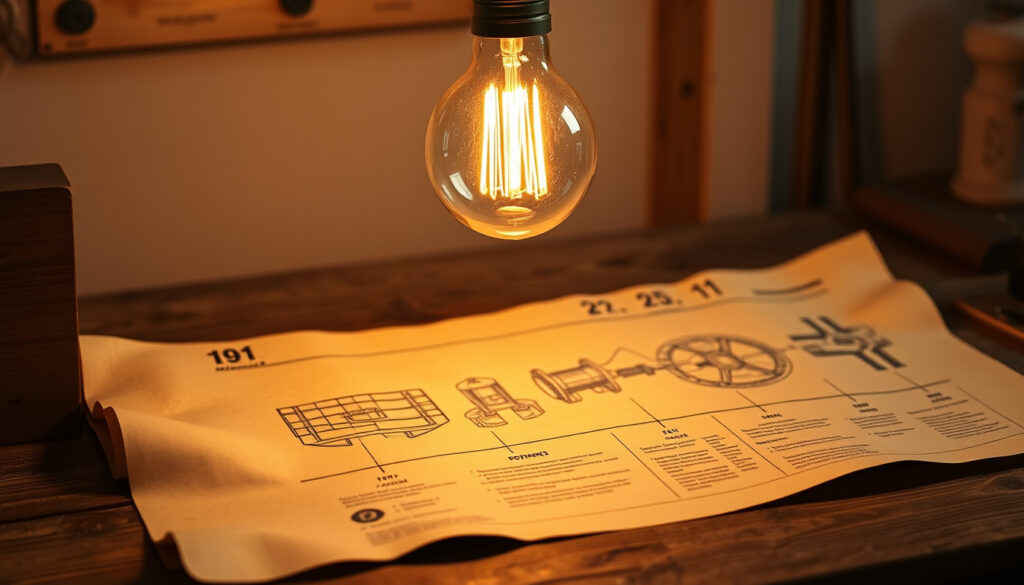
Who Invented the Lightbulb – Facts, Myths and Timeline
The question of who invented the lightbulb has a more complicated answer than most people realize. Thomas Edison receives widespread credit for the invention, but the reality involves decades of experimentation by multiple inventors across several countries. Understanding this history reveals why the lightbulb cannot be attributed to a single person.
This article examines the evidence behind the invention, separates established facts from persistent myths, and traces the evolution of the technology from early laboratory demonstrations to practical household lighting. The documented timeline shows contributions spanning more than 75 years before Edison’s commercial breakthrough.
The Lightbulb Invention: Facts and Fiction
Edison did not invent the lightbulb from scratch. He perfected a viable, long-lasting, affordable version after conducting over 1,200 experiments, acquiring existing patents such as Woodward-Evans, and focusing on improvements in bamboo filaments and high-vacuum technology. His achievement was practical commercialization rather than original invention.
Thomas Edison invented the lightbulb in 1879
Edison created the first commercially practical version
Multiple inventors demonstrated electric light principles before Edison
Edison’s combination of filament, vacuum, and power system made bulbs viable for homes
Key Facts About the Lightbulb Invention
- Humphry Davy demonstrated the incandescent light principle in 1802 using electric current heated platinum strips
- Thomas Edison patented a practical incandescent bulb in 1879 (U.S. Patent 223,898) with a carbonized cotton filament lasting 14.5 hours
- Edison improved his design to 1,200 hours by 1880 using bamboo filaments in high vacuum
- The evolution shifted from early platinum filaments to carbonized materials, then to tungsten by 1910
- Lewis Latimer, an associate of Edison, patented carbon filament improvements in 1881-82
- Edison’s Menlo Park laboratory and integrated power systems enabled widespread commercialization
| Milestone | Inventor/Date | Details |
|---|---|---|
| First electric light demonstration | Humphry Davy (1802) | Electric battery experiments producing arc-like incandescence brighter than 1,000 candles |
| Early incandescent bulb concept | Warren de la Rue (1840) | Coiled platinum filament in vacuum tube; effective but prohibitively expensive |
| Carbon filament vacuum bulb | Joseph Wilson Swan (1850s-60s) | Carbonized paper filaments in evacuated glass; prototypes worked but short-lived |
| Practical commercial bulb | Thomas Edison (1879) | Carbonized cotton filament in vacuum, lasting 14.5 hours initially, then 1,200 hours with bamboo |
| Tungsten filament standard | William Coolidge (1910) | Superior durability and efficiency replaced carbon and bamboo filaments |
Who Invented the Lightbulb Before Edison?
Before Edison’s commercial success, numerous inventors developed incandescent concepts, focusing on filaments, vacuums, and different atmospheric conditions. None achieved commercial viability due to short lifespans, high costs, or poor efficiency.
Early Pioneers in Electric Lighting
In 1802 and again in 1809, Humphry Davy at the Royal Institution in London passed electric current through platinum strips using a massive battery of 2,000 cells. The resulting bright arc-like incandescence exceeded 1,000 candles in intensity. While this demonstration proved electricity could heat materials to glow, it was not enclosed in a bulb and lasted only briefly.
James Bowman Lindsay demonstrated constant electric light contained in a glass bulb in 1835, though reliability remained a problem. In 1838, Marcellin Jobard of Belgium invented a bulb using a carbon filament in a vacuum atmosphere. Warren de la Rue in England in 1840 created a coiled platinum filament in a vacuum tube that proved effective, but platinum’s cost made commercialization impossible.
Joseph Wilson Swan in England during the 1850s and 1860s developed carbonized paper filaments in evacuated glass bulbs. His prototypes worked but suffered from inadequate vacuum technology and insufficient power supplies. The carbon rod burners developed by Alexander Lodygin in Russia in 1872 (patented 1874) used nitrogen-filled sealed glass, though rod consumption remained problematic.
Earlier inventors produced functional demonstrations but could not achieve the combination of long filament life, sufficient vacuum, and affordable materials needed for practical household use. Edison’s genius lay in solving all three problems simultaneously.
Who Invented the Lightbulb Filament?
The filament, the glowing wire at the center of the bulb, underwent significant evolution. Early experiments used platinum because it could withstand high temperatures, but the metal’s cost made mass production impractical.
Evolution of Filament Materials
Davy and de la Rue used platinum strips and coils, establishing the basic principle of incandescence. Swan introduced carbonized paper as a filament material, demonstrating that carbon could work effectively despite the technical limitations of his era. Edison initially used carbonized cotton thread filaments, which achieved 14.5 hours of continuous light in his 1879 demonstration.
The breakthrough came when Edison switched to bamboo filaments in 1880, extending the bulb’s life to 1,200 hours. This material choice proved crucial for commercialization. William Coolidge at General Electric developed tungsten filaments in 1910, which offered superior durability and efficiency, eventually becoming the standard for incandescent bulbs.
| Period | Material | Key Innovation | Limitation |
|---|---|---|---|
| 1802-1840 | Platinum | First incandescence demonstrations | Costly, short duration |
| 1850s-1860s | Carbonized paper | Affordable carbon filament | Poor vacuum technology |
| 1879 | Carbonized cotton | First practical 14.5-hour bulb | Limited lifespan |
| 1880 | Bamboo | 1,200-hour commercial bulb | Material scarcity |
| 1910 | Tungsten | Modern standard filament | None; became industry standard |
The progression from platinum to carbon to tungsten took over a century of experimentation. Each material transition addressed specific limitations of its predecessors, with tungsten finally offering the ideal combination of high melting point, conductivity, and cost-effectiveness.
Did Nikola Tesla Invent the Lightbulb?
Tesla did not invent the lightbulb. This claim represents a persistent myth that conflates his important contributions to electrical engineering with an invention he did not make.
Tesla’s Actual Role in Electrical History
Tesla briefly collaborated with Edison in the 1880s but departed due to disputes over compensation and technical disagreements. His contributions to electrical technology were substantial but focused on alternating current systems, motors, and wireless transmission rather than incandescent lighting.
In 1893, Tesla developed a wireless electrical lamp as part of his demonstrations for AC power systems at the World’s Columbian Exposition in Chicago. This device was a demonstration tool for wireless power transmission concepts, not a practical incandescent bulb competing with Edison’s design.
While Tesla made crucial contributions to electrical engineering through his work on AC power systems, attributing the lightbulb invention to him contradicts the documented historical record. His role in electrical history is significant enough without false claims.
How Was the Lightbulb Invented?
The invention process spanned more than seven decades, with incremental advances building upon previous discoveries. Understanding this timeline clarifies why multiple inventors contributed to the final technology.
Chronology of Electric Light Development
- 1802: Humphry Davy demonstrates electric incandescence using platinum and a massive battery at the Royal Institution in London
- 1841: Arc lamps illuminate Paris streets, marking the first city street lighting using Davy’s principles
- 1856: Heinrich Geissler develops the Geissler tube for containing electric charge, a precursor to neon and fluorescent lighting technology
- 1872: Alexander Lodygin patents a carbon rod burner in nitrogen-filled sealed glass in Russia
- 1875: Woodward and Evans patent nitrogen-filled carbon rod lamps; their patent sells to Edison in 1879
- 1879: Edison patents his practical incandescent bulb (U.S. Patent 223,898) with carbonized cotton filament lasting 14.5 hours
- 1880: Edison improves his design to 1,200 hours using bamboo filaments and high vacuum technology
- 1883: Joseph Wilson Swan merges his British company with Edison’s operations, combining their technologies
- 1910: William Coolidge introduces tungsten filaments, establishing the modern standard
What Evidence Confirms the Historical Record?
The historical record regarding the lightbulb’s invention rests on multiple categories of evidence that establish both what is definitively known and what remains uncertain.
Established Facts vs. Unresolved Questions
| What Is Established | What Remains Unclear |
|---|---|
| Davy demonstrated electric incandescence in 1802 | Whether any 1854 Göbel bulbs actually functioned as claimed |
| Edison patented a practical bulb in 1879 | The complete extent of pre-Edison experimentation in non-Western countries |
| Edison conducted over 1,200 experiments before success | The precise contributions of specific laboratory assistants |
| Courts upheld Edison’s 1883 patent consolidation against 23 lawsuits | Some details of the Woodward-Evans patent acquisition terms |
| Tesla developed wireless lamps in 1893, not incandescent bulbs | Exact prioritization of development goals in various laboratories |
The claim of Heinrich Göbel, dating to 1854, alleged thin carbonized bamboo filaments in high-vacuum glass bulbs with platinum wires. Court claims in 1893 attempted to dispute Edison’s priority. However, research conducted in 2007 analyzed the available evidence and concluded this claim lacks verification—the bulb attributed to Göbel is now regarded as a legend without proof of actual working lamps.
The Context Behind Edison’s Recognition
Edison received credit for the lightbulb invention because he solved the final barriers preventing practical household use. While others produced functional demonstrations, Edison combined effective filaments, reliable vacuum technology, and an affordable product supported by electrical distribution infrastructure.
His Menlo Park laboratory operated as an organized research facility, employing systematic experimentation rather than accidental discovery. By 1880, his bamboo filament bulbs lasting 1,200 hours represented a 50-fold improvement over his initial 1879 demonstration. This improvement transformed electric lighting from a laboratory curiosity into a commercial product.
Edison also built the necessary infrastructure, including power generation and distribution systems, enabling homes to receive electricity. This integration of bulb design with power delivery systems distinguished his achievement from earlier demonstrations that lacked practical application methods.
Sources and Historical Documentation
Edison did not invent the light bulb from scratch but perfected a viable, long-lasting, affordable version after 1,200+ experiments, buying patents like Woodward-Evans and focusing on bamboo filament and high vacuum.
U.S. Department of Energy, History of the Light Bulb
Humphry Davy passed current through platinum strips via a massive battery (2,000 cells) at the Royal Institution, producing bright arc-like incandescence brighter than 1,000 candles; first proof electricity could heat materials to glow.
Edison bulb historical timelines and records
Summary
The lightbulb was not invented by a single person. Humphry Davy established the principle of electric incandescence in 1802, multiple inventors contributed filament and vacuum innovations throughout the 19th century, and Thomas Edison created the first commercially practical version in 1879 by combining effective materials with systematic engineering. Edison’s achievement lay in perfecting existing concepts rather than inventing from nothing, making him both deserving and undeserving of sole credit depending on how one defines invention. For more on the timeline of electrical discoveries, see the timeline of human infectious disease research.
Frequently Asked Questions
Who invented electricity?
Electricity as a natural phenomenon was not invented but discovered. Benjamin Franklin demonstrated this through his famous kite experiment in 1752, proving that lightning was electrical in nature.
Who invented the lightbulb woman?
No prominent female figures appear in the documented history of incandescent lighting development based on available sources. Searches of historical records yield no verified claims of women inventing core lightbulb technology.
Who invented the lightbulb Black History?
Lewis Latimer worked as an associate of Edison and patented carbon filament improvements in 1881-82. However, these were refinements of existing technology rather than original lightbulb invention.
Who invented the light bulb and telephone?
Alexander Graham Bell invented the telephone in 1876, while Thomas Edison developed the practical lightbulb in 1879. These were distinct inventions created by different inventors working in different fields.
Who invented the lightbulb in 1879?
Thomas Edison patented the practical incandescent bulb in 1879 under U.S. Patent 223,898. His design used a carbonized cotton filament that lasted 14.5 hours before the vacuum failed.
Did Benjamin Franklin invent the light bulb?
No. Franklin demonstrated the electrical principle through his kite experiment in 1752 but did not create an incandescent light bulb. His work concerned static electricity rather than practical electric lighting.
More related posts
 Fantastic Beasts 2: Box Office, Cast Changes & Cancellation
 Best Places to Watch Whales – Top Global Destinations and Seasons
 Kylie Jenner Met Gala 2026: Dress, Mishap, Chalamet Absent
 Walmart December 25 Closure 2025: Why Stores Shut & Reopen
 Matthew 6:33 Meaning: Seek First the Kingdom of God (Guide)
 Miracle on 34th Street 1947 Cast: Full List & Where They Are Now
 Cast of 9-1-1: Nashville – Main Actors & Premiere Date