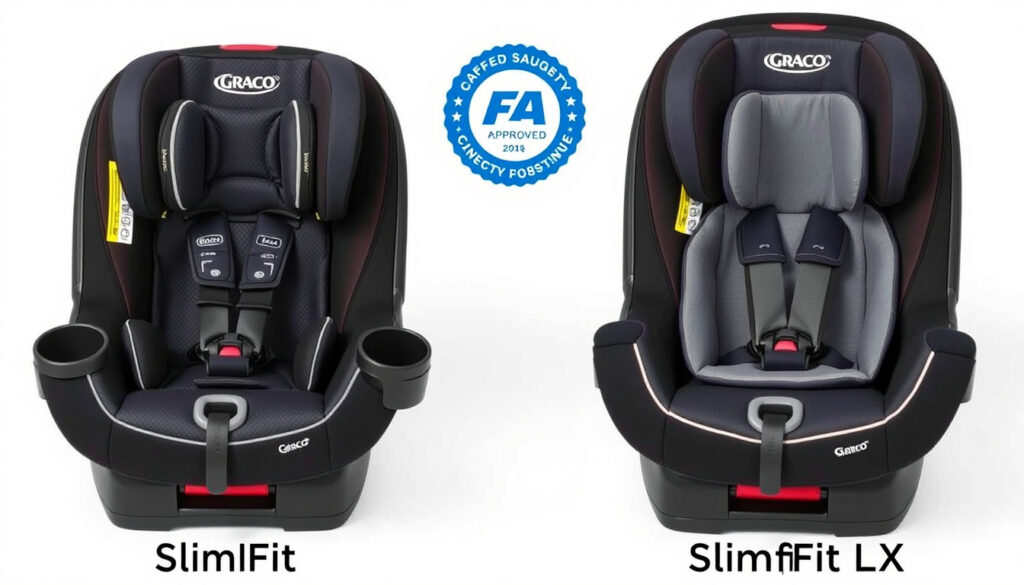
Graco SlimFit 3-in-1 Car Seat: SlimFit vs SlimFit LX – Specs, FAA Approval & More
Few parenting purchases feel as consequential as the car seat. You’ve read the specs, compared the prices, and narrowed it down to the Graco SlimFit — but then you notice there’s also a SlimFit LX, and suddenly the decision feels bigger than a single letter.
Graco SlimFit vs. SlimFit LX: Key facts at a glance
Confirmed facts
- Graco Children’s Products Inc.
- Both models are part of the SlimFit family, designed for narrow vehicles.
- 3-in-1 car seat: rear-facing, forward-facing, highback booster.
- LX adds the InRight LATCH system with one-pull tightener.
- Rear-facing: 5–40 lb
- Forward-facing: 22–65 lb
- Highback booster: 40–100 lb
- Seat width: 17.1 in
- Expiration: 7 years from manufacture date
- No-rethread harness on both models
The SlimFit LX is essentially the premium trim of the SlimFit line: same shell, same weight limits, same slim profile — but with the InRight LATCH system that makes installation noticeably easier. If you’re comparing purely on specs, the two seats are twins; the real difference emerges in daily use.
What’s the actual difference between the SlimFit and SlimFit LX?
The core difference is the InRight LATCH system — a one-pull tightener that Graco says reduces installation effort. The standard SlimFit uses a traditional LATCH connector that requires more fiddling. According to Graco’s official SlimFit LX product page (manufacturer documentation), the InRight system is designed to get a tight fit with a single pull, which is a meaningful upgrade for parents who install and reinstall seats frequently.
Beyond LATCH, the LX adds premium comfort padding. The SlimFit has a plush seat, but the LX features thicker side-impact foam and a more cushioned headrest — a detail that matters on long drives. A review from Car Seats for the Littles (a child passenger safety advocacy group) notes that the LX’s padding is noticeably softer, though both seats meet the same federal safety standards.
FAA approval: Which SlimFit model can you take on a plane?
Here’s the nuance that most parents miss: both the SlimFit and SlimFit LX are FAA-approved, but only in forward-facing mode. The seats are certified for use on aircraft when installed forward-facing with the vehicle belt — they are not approved for rear-facing airplane installation. According to Graco’s product documentation, the FAA approval label is affixed to the seat’s side, confirming it meets the requirements for airplane use in the forward-facing orientation.
There’s a critical caveat: the SlimFit must not be used in booster mode on an airplane. A specialist article from JetMum (a family travel resource) explains that only car seats with a 5-point harness are permitted on aircraft — booster mode lacks the harness, so it’s a no-go. Additionally, the seat’s base must be removed for forward-facing installation on a plane, and the seat must be installed with the aircraft’s lap belt routed correctly.
Comparing the SlimFit and SlimFit LX side by side
The cleanest way to see the trade-off is to put the two seats next to each other — same weight limits, same slim shell, but different convenience features that affect daily life.
| Feature | SlimFit | SlimFit LX |
|---|---|---|
| InRight LATCH system | No (standard LATCH) | Yes (one-pull tightener) |
| No-rethread harness | Yes | Yes |
| Side-impact protection | Standard EPS foam | Reinforced headrest foam |
| FAA approval | Yes (forward-facing) | Yes (forward-facing) |
| Rear-facing weight range | 5–40 lb | 5–40 lb |
| Forward-facing weight range | 22–65 lb | 22–65 lb |
| Highback booster weight range | 40–100 lb | 40–100 lb |
| Seat width | 17.1 in | 17.1 in |
| Expiration | 7 years | 7 years |
The table reveals that the LX isn’t a different seat — it’s a better-executed version of the same idea. The InRight LATCH and extra padding are the only material upgrades, and for many families, those upgrades are worth the extra $30–$50. However, if you rarely move the seat between cars or don’t mind a bit of LATCH fiddling, the standard SlimFit remains an excellent value.
Product specifications: What’s under the hood
Beyond the marketing bullet points, the SlimFit family shares a common structural platform — here’s what that means for installation and longevity.
| Specification | Value |
|---|---|
| Manufacturer | Graco Children’s Products Inc. |
| Seat type | 3-in-1 (rear-facing, forward-facing, highback booster) |
| Rear-facing weight range | 5–40 lb |
| Forward-facing weight range | 22–65 lb |
| Highback booster weight range | 40–100 lb |
| Seat width | 17.1 in |
| Expiration period | 7 years from manufacture date |
| FAA certified | Yes (forward-facing mode only) |
| Installation features | InRight LATCH (LX) / standard LATCH (SlimFit) |
| Harness type | No-rethread, 5-point harness |
The spec sheet confirms that both seats share the same structural limits — the LX doesn’t extend the weight ranges or add new modes. The real difference is in the user experience: the LX’s InRight LATCH is a genuine convenience upgrade, and the thicker padding makes the seat more comfortable for longer rides.
Pros and cons of the SlimFit LX (and where the SlimFit wins)
Pros of the SlimFit LX
- InRight LATCH: The one-pull tightener is a genuine upgrade — installation is noticeably quicker, as confirmed by Car Seats for the Littles (a car seat safety organization).
- Premium padding: Thicker headrest foam and side-impact cushioning make long trips more comfortable.
- FAA-approved: Both models are certified for forward-facing airplane use, which is a rare feature at this price point.
- No-rethread harness: Adjusting the harness height doesn’t require rethreading — a feature parents love.
Cons of the SlimFit LX
- Higher price: The LX typically costs $30–$50 more than the SlimFit, and the base model is already mid-range.
- Same weight limits: The LX doesn’t extend the rear-facing or forward-facing limits — it’s the same 40 lb/65 lb/100 lb ranges.
- No rear-facing FAA approval: If your child is still rear-facing, you can’t use this seat on a plane in that mode.
The SlimFit LX’s advantages are real but concentrated: LATCH convenience and comfort. For a family that installs the seat once and leaves it, the base SlimFit is the smarter value. For frequent travelers or parents who switch seats between cars, the LX’s ease of installation is a daily time-saver that justifies the premium.
Step-by-step: Installing the Graco SlimFit LX for airplane travel
Airplane installation has specific steps that differ from car installation — and getting them right is essential for safety and compliance. Here’s the process, based on Graco’s official instructions and specialist guidance from JetMum.
- Remove the base from the SlimFit LX — this is mandatory for forward-facing installation on an aircraft.
- Place the seat forward-facing on the airplane seat, ensuring it fits between the armrests (the 17.1 in width usually fits standard economy seats).
- Route the airplane lap belt through the forward-facing belt path, following the red indicators on the seat shell.
- Buckle the lap belt and tighten it firmly — the seat should not move more than 1 inch side-to-side at the belt path.
- Verify the FAA approval label is visible on the side of the seat, confirming certified airplane use.
- Keep your child in the 5-point harness — booster mode is not permitted on any aircraft.
SlimFit vs. SlimFit LX: Timeline of key milestones
Understanding how the seat transitions across your child’s growth is the best way to plan your purchase.
- Birth to 40 lb (rear-facing): Both seats handle rear-facing from 5 lb, and Graco recommends keeping children rear-facing as long as possible — up to 40 lb or until the child’s head is within 1 inch of the top of the headrest.
- 22–65 lb (forward-facing): Once your child outgrows rear-facing limits, switch to forward-facing with the harness. Remember to remove the base if you’re installing on a plane.
- 40–100 lb (highback booster): The harness must be removed entirely when transitioning to booster mode — the seat functions as a highback booster, but this mode is not FAA-certified for flights.
The timeline shows that both seats offer the same longevity — 7 years from the manufacture date. That means a single purchase can plausibly cover a child from infancy to booster age, though the transition points require careful attention to avoid using the seat in an unapproved mode.
What’s verified vs. what’s still unclear
When it comes to car seats, clarity matters — here’s what’s confirmed by manufacturer or specialist sources, and where the public record has gaps.
Confirmed facts
- The SlimFit LX includes the InRight LATCH system with a one-pull tightener, per Graco’s official documentation.
- Both seats are FAA-approved for forward-facing airplane use — the label is affixed to the seat side.
- Keep children rear-facing as long as possible, up to 40 lb or the child’s head is within 1 inch of the top of the headrest, according to Car Seats for the Littles.
- The SlimFit must be installed in forward-facing mode on an aircraft — the base must be removed, per Graco’s instructions.
- The seat does not have a rear-facing FAA certification, so it cannot be used rear-facing on a plane.
What’s not fully verified
- Whether the SlimFit LX’s extra padding provides measurably better crash protection — both seats meet the same federal standards, but independent crash test data for the LX specifically is not publicly available.
- Exact airline seat compatibility: the seat’s 17.1 in width fits most economy seats, but individual aircraft configurations vary.
The split between confirmed and speculative is important: the core safety and compliance facts are well documented by Graco and specialist groups, but the finer points of crash performance and airline fit rely on inference. For most families, the confirmed facts are sufficient to make a confident choice.
What the experts say: Real-world perspectives
Beyond the spec sheets, car seat specialists and travel experts have hands-on experience that reveals how these seats perform in practice.
“Children should ride rear-facing as long as possible, which for the SlimFit means until they outgrow the 40 lb limit or the headrest is at its maximum height. That’s a long time in a car seat, so comfort is a real consideration.”
— Car Seats for the Littles (child passenger safety advocacy group)
“The SlimFit is a popular choice for travel because it’s narrow enough to fit airplane seats, but you must use it in harness mode — booster mode is not allowed on any aircraft.”
“The InRight LATCH is a meaningful upgrade — it takes the guesswork out of getting a tight installation. For families who move the seat between cars, that’s a daily convenience.”
— Graco (manufacturer documentation)
The expert consensus is clear: the SlimFit LX earns its premium through installation ease and comfort, while the base SlimFit remains a solid, budget-friendly alternative. For families who travel often, the LX’s LATCH system is the feature that makes the difference.
babygearabc.com, jetmum.com, manual.nz, gracobaby.com.tw, uksupport.gracobaby.eu, carseaton.com, manuals.ca, m.media-amazon.com, thecarseatpros.com, xn--vg1b14l6tk.xn--3e0b707e
Frequently asked questions
Is the Graco SlimFit LX FAA-approved for airplanes?
Yes, the SlimFit LX is FAA-approved for forward-facing airplane use, as confirmed by the label on the seat’s side. It must be installed forward-facing in harness mode — rear-facing and booster modes are not permitted on aircraft.
Can the SlimFit LX be used rear-facing on a plane?
No, the FAA approval for the SlimFit LX covers forward-facing installation only. The seat cannot be used rear-facing on an airplane, so if your child is still rear-facing in the car, you’ll need a different seat for the flight.
What is the weight limit for the SlimFit LX in rear-facing mode?
The SlimFit LX supports rear-facing from 5 to 40 lb. Graco recommends keeping children rear-facing until they reach the 40 lb limit or until their head is within 1 inch of the top of the headrest.
Does the SlimFit LX have a no-rethread harness?
Yes, both the SlimFit and SlimFit LX feature a no-rethread harness. The headrest and harness move as one unit, simplifying adjustments as your child grows.
What is the difference between the SlimFit and SlimFit LX?
The SlimFit LX includes the InRight LATCH system with a one-pull tightener and added comfort padding, while the SlimFit has standard LATCH and thinner padding. Both seats have identical weight limits and the same 7-year expiration.
How long does the Graco SlimFit LX last?
The SlimFit LX expires 7 years from the manufacture date. This means it can typically cover a child from infancy to booster age, though the usable period depends on the child’s growth rate.
Related reading
For more context on car seat safety and travel, explore these additional resources: Car Seats for the Littles’ full SlimFit review breaks down real-world testing, while JetMum’s airplane-specific guide covers airline policies and installation tips.
More related posts
 Live Action How to Train Your Dragon – Cast, Release, Production Details
 Listen for the Lie: Book Summary, Ending, Movie News & Reviews
 From Season 4 Release Date: Premiere, Schedule & How to Watch
 Home Sweet Home Alone – Plot, Cast, Reviews Guide
 Chicken Pot Pie Casserole – Easy 45-Min Family Dinner
 Guardians of the Galaxy Cast: Full List & Who Almost Played
 Salary to Hourly Calculator Ireland: Formulas & Taxes