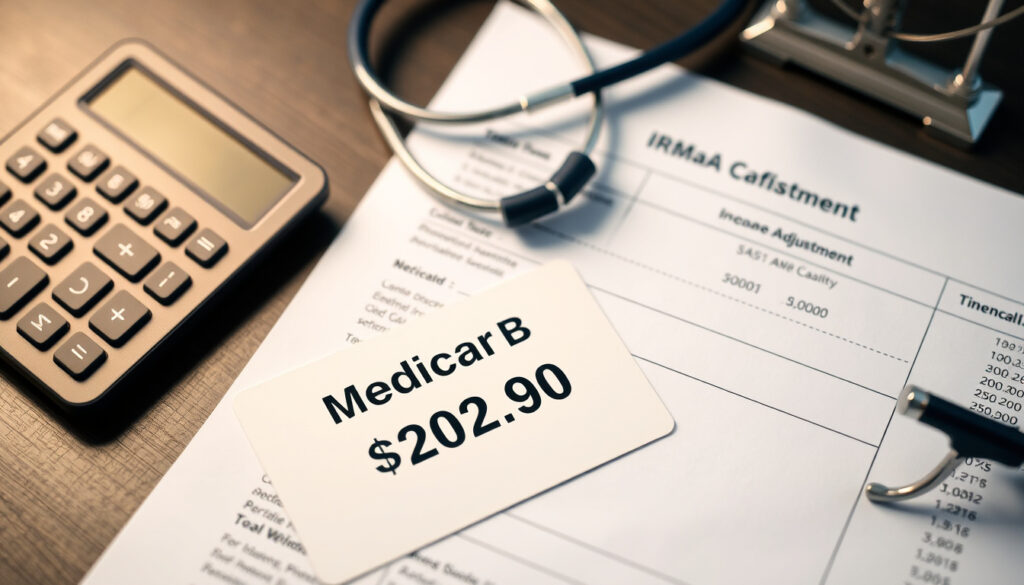
2026 Medicare Part B Premium: $202.90 Cost & IRMAA Guide
Few numbers hit a retiree’s budget quite like the Medicare Part B premium, which rose to $202.90 per month in 2026 — a $17.90 jump that arrives alongside a Social Security COLA of 2.5%, leaving many seniors feeling the squeeze. Here is exactly what the new costs mean, which income brackets trigger additional charges, and how the math works out of your paycheck.
Standard monthly premium (2026): $202.90 ·
Increase from 2025: $17.90 ·
Annual deductible (2026): $283 ·
Highest income bracket premium: $689.90 per person ·
IRMAA income threshold for highest bracket: $750,000 (couple) ·
Social Security COLA increase (2026): 2.5%
Quick snapshot
- Standard Part B premium for 2026 is $202.90/month (Centers for Medicare & Medicaid Services (CMS official fact sheet))
- Annual deductible is $283 (CMS official fact sheet)
- Income-related adjustments apply above $106,000 (single) / $212,000 (joint) (Social Security Administration (IRMAA form instructions))
- Highest premium tier reaches $689.90/month for incomes over $500,000 (single) / $750,000 (joint) (CMS official fact sheet)
- Exact impact on individual Social Security checks depends on personal COLAs and deductions
- Future premium increases beyond 2026 are not yet determined
- Whether the premium will rise further due to inflation or policy changes is uncertain
- CMS announced 2026 premiums on November 14, 2025 (CMS official fact sheet)
- New rates take effect January 1, 2026 (CMS official fact sheet)
- IRMAA notices sent to beneficiaries in late 2025 (CMS official fact sheet)
- Beneficiaries should review their IRMAA notice when it arrives
- Check whether Social Security deductions will cover the full premium
- Appeal IRMAA if your income dropped due to life-changing event
Seven key figures define your 2026 Medicare Part B costs, from the base premium to the highest income-adjusted tier. The pattern is clear: the gap between what low-income and high-income enrollees pay continues to widen.
| Metric | Value (2026) |
|---|---|
| Standard monthly premium | $202.90 |
| Annual deductible | $283 |
| Income threshold for standard premium (single) | ≤ $106,000 MAGI |
| Income threshold for standard premium (joint) | ≤ $212,000 MAGI |
| Highest premium (single, >$500k MAGI) | $689.90 |
| Highest premium (joint, >$750k MAGI) | $689.90 per person |
| Premium increase from 2025 | +$17.90 (9.7%) |
How much will Medicare Part B cost in 2026?
Standard monthly premium for 2026
- The standard Part B premium in 2026 is $202.90 per month for most enrollees (Centers for Medicare & Medicaid Services (CMS official fact sheet)).
- This covers physician visits, outpatient care, preventive services, and durable medical equipment under Original Medicare (Medicare.gov (beneficiary-facing cost publication)).
How much is the increase from 2025?
- The 2025 premium was $185.00, making the 2026 increase $17.90 — a 9.7% rise (Centers for Medicare & Medicaid Services (CMS official fact sheet)).
- This is one of the largest year-over-year dollar increases in the last decade, though percentage-wise it follows a trend line similar to 2024, when the premium jumped from $164.90 to $174.70.
Who pays the standard premium?
- About 70% of Part B enrollees pay the standard premium because their modified adjusted gross income is at or below $106,000 (single) or $212,000 (joint) (Medicare.gov cost publication).
- If your income exceeds those thresholds, you pay the standard premium plus an income-related monthly adjustment amount (IRMAA).
For the majority of beneficiaries, the $17.90 increase lands as a fixed monthly cost. But the real bite shows up when you compare it to the 2026 Social Security COLA: a retiree receiving the average benefit of roughly $1,960 per month gets about $49 extra per month from the COLA — meaning the Part B increase alone consumes more than a third of that raise.
The implication: retirees should factor this premium increase into their 2026 budget planning, especially since it erodes a significant portion of the COLA gain.
What are the income limits for Medicare premiums in 2026?
IRMAA income thresholds for 2026
- Income-related monthly adjustment amounts apply when your modified adjusted gross income exceeds $106,000 (single filers) or $212,000 (married filing jointly) (Social Security Administration (IRMAA form SSA-44)).
- The thresholds have risen modestly from 2025 levels, reflecting inflation indexing.
Premium amounts by income bracket (single and joint)
- Premiums range from $202.90 at the lowest bracket to $689.90 per person at the highest bracket (Centers for Medicare & Medicaid Services (CMS official fact sheet)).
- The IRMAA add-on for the first tier above the standard threshold is $81.20 per month; for the top tier it reaches $544.30 per month (Centers for Medicare & Medicaid Services (CMS official fact sheet)).
- Railroad annuitants see IRMAA adjustments ranging from $14.50 to $91.00 depending on income tier (Railroad Retirement Board (RRB official release)).
How to know if you pay IRMAA
- The Social Security Administration uses your tax return from two years prior (2024 tax returns for 2026 premiums) to determine your IRMAA status (Social Security Administration (IRMAA form instructions)).
- If your income has dropped due to retirement, divorce, death of a spouse, or other life-changing events, you can file Form SSA-44 to request a redetermination.
High-income retirees in the top bracket pay $689.90 per person per month — that’s $8,278.80 annually for a single person, or $16,557.60 for a couple both on Part B. For those households, the Part B premium alone can exceed what many retirees pay for their entire mortgage or rent.
What this means: high-income households must treat Part B premiums as a major fixed expense, potentially rivaling housing costs.
What is the deductible for Medicare Part B in 2026?
2026 Part B deductible amount
- The annual Part B deductible for 2026 is $283 (Centers for Medicare & Medicaid Services (CMS official fact sheet)).
- This represents a $26 increase from the 2025 deductible of $257.
How the deductible works in Original Medicare
- You pay 100% of Part B-covered costs until you meet the $283 deductible each calendar year (Medicare.gov cost publication).
- After the deductible is met, Medicare pays 80% of the approved amount for covered services; you pay the remaining 20% coinsurance with no out-of-pocket maximum.
Changes from 2025 deductible
- The $26 increase (10.1%) outpaces general inflation and reflects rising costs in physician and outpatient services (Centers for Medicare & Medicaid Services (CMS official fact sheet)).
- Over the past five years, the deductible has risen from $203 (2022) to $283 (2026) — a cumulative 39% increase.
The pattern: the deductible is rising faster than general inflation, meaning beneficiaries face higher upfront costs before Medicare coverage kicks in.
How is the Part B premium determined?
Role of the Medicare Board of Trustees
- The Part B premium is set annually based on projected program costs for the coming year, as estimated by the Medicare Board of Trustees (Centers for Medicare & Medicaid Services (CMS official fact sheet)).
- The standard premium is designed to cover 25% of Part B program spending, with the remaining 75% funded by general federal revenue.
Cost of Part B program and premium setting
- Projected spending increases for physician services, hospital outpatient care, and prescription drug administration drive premium growth (Centers for Medicare & Medicaid Services (CMS official fact sheet)).
- Inflation in healthcare labor and supply costs, along with utilization trends, factor into the annual calculation.
Income-related adjustment (IRMAA) calculation
- IRMAA is calculated using your modified adjusted gross income from two years prior — so your 2024 tax return determines your 2026 premium (Social Security Administration (IRMAA form SSA-44)).
- The Social Security Administration applies a sliding scale: five income tiers for single filers and five for joint filers, each with a fixed IRMAA dollar amount added to the base premium (Centers for Medicare & Medicaid Services (CMS official fact sheet)).
The catch: the two-year lookback means a high-income year can cause a surcharge even if current income is lower, making timely appeals essential.
What is the Medicare Part B premium for 2026 calculator?
Using the online IRMAA calculator on SSA.gov
- The Social Security Administration provides an IRMAA calculator at SSA.gov to help estimate your total Part B cost based on income and filing status (Social Security Administration (IRMAA form and instructions)).
- Input your estimated 2024 MAGI and filing status to see which bracket applies and what your monthly premium — base plus IRMAA — would be.
How to estimate your total Part B cost
- Start with the standard premium of $202.90, then add your IRMAA tier amount from the CMS bracket table (Centers for Medicare & Medicaid Services (CMS official fact sheet)).
- For example, a single filer with 2024 MAGI of $150,000 falls into the first IRMAA tier (income $106,001–$133,000) and pays $202.90 + $81.20 = $284.10 per month.
- A couple filing jointly with combined MAGI of $500,000 falls into the fourth tier and each person pays $202.90 + $380.90 = $583.80 per month.
Factors affecting your premium: income, late enrollment penalties
- Late enrollment penalties add 10% of the standard premium for each full 12-month period you were eligible but did not enroll (Medicare.gov cost publication).
- This penalty is permanent for as long as you have Part B coverage — it does not expire.
The two-year lookback means a high-income year in 2024 could trigger an IRMAA surcharge in 2026 even if your current income has dropped. Beneficiaries who retired mid-2024 or had a one-time capital gain should file Form SSA-44 immediately to request an income redetermination.
The takeaway: use the SSA calculator and check your 2024 tax return to avoid an unwelcome surprise in 2026.
What does the 2026 Medicare Part B premium increase chart show?
Visual breakdown of premium increases over years
- The 2026 premium of $202.90 continues a steady upward climb from $135.50 in 2019 — a cumulative increase of 49.7% over eight years (CMS historical premium data).
- The $17.90 dollar increase from 2025 to 2026 is tied for the largest single-year jump in the past decade alongside the 2022 increase (from $148.50 to $170.10).
Comparison of 2026 premium with previous years (2019–2025)
- 2019: $135.50 → 2020: $144.60 → 2021: $148.50 → 2022: $170.10 → 2023: $164.90 → 2024: $174.70 → 2025: $185.00 → 2026: $202.90 (CMS official annual data).
- The 2023 premium decreased slightly due to a one-time adjustment related to Aduhelm spending projections that did not materialize.
Impact of inflation and healthcare costs on premiums
- Inflation in medical care services (physician visits, hospital outpatient procedures) runs consistently above general inflation, putting upward pressure on Part B costs (Centers for Medicare & Medicaid Services (CMS official fact sheet)).
- The Center for Retirement Research at Boston College estimates that higher Medicare premiums will consume more than 25% of the 2026 Social Security COLA for many retirees (Center for Retirement Research at Boston College (retirement policy analysis)).
- AARP reported the 2026 COLA was expected to add about $56 per month to the average Social Security check — meaning the Part B premium increase alone could absorb nearly one-third of that raise (AARP (Social Security policy coverage)).
The pattern: Part B costs are rising faster than Social Security COLAs, and the gap is compounding. For a retiree who paid $144.60 per month in 2020, the 2026 premium of $202.90 represents a 40% increase in six years, while Social Security COLAs over that same period totaled roughly 23% cumulatively.
Timeline: key dates for the 2026 Medicare Part B premium
- October 2025 — Social Security announces 2026 COLA of 2.5% (AARP (Social Security changes coverage)).
- November 14, 2025 — CMS releases fact sheet announcing 2026 Part B premium and deductible (Centers for Medicare & Medicaid Services (CMS official fact sheet)).
- Late 2025 — IRMAA notices sent to affected beneficiaries (Social Security Administration (IRMAA form instructions)).
- January 1, 2026 — New Part B premium and deductible take effect.
For a couple with a combined income of $218,000 or less (within the standard premium bracket), the Part B increase consumes roughly $36 of the $56 monthly COLA gain — leaving just $20 extra per month before Part D and Medigap premium increases are considered. High-income couples in the top IRMAA tier face an additional $544.30 per person per month, effectively wiping out the entire COLA and then some.
The implication: beneficiaries should evaluate their total Medicare costs, including Part D and Medigap, when assessing the net COLA benefit.
Confirmed facts
- Standard Part B premium for 2026 is $202.90 per month (Centers for Medicare & Medicaid Services (CMS official fact sheet)).
- Annual deductible is $283 (Centers for Medicare & Medicaid Services (CMS official fact sheet)).
- IRMAA brackets and premium amounts are set by CMS and published in the November 2025 fact sheet (Centers for Medicare & Medicaid Services (CMS official fact sheet)).
- Premium increase is $17.90 from 2025 (Centers for Medicare & Medicaid Services (CMS official fact sheet)).
These four figures are directly sourced from the CMS official fact sheet, providing a reliable baseline for planning.
What’s unclear
- Exact impact on individual Social Security checks depends on personal COLAs, Medicare premium deductions, and Part D cost changes.
- Future premium increases beyond 2026 are not yet determined — CMS projects but does not lock rates beyond one year.
- Whether the premium will rise further due to inflation, new drug costs, or policy changes is uncertain.
- The exact impact of Part D premium changes on overall Medicare costs for 2026 is not yet known.
What experts are saying
“The standard monthly premium for Medicare Part B enrollees will be $202.90 for 2026, an increase of $17.90 from $185.00 in 2025.”
— Centers for Medicare & Medicaid Services, November 2025 fact sheet (CMS official release)
“Most people pay the standard Part B monthly premium amount ($202.90 in 2026). If your income is above a certain limit, you pay an additional premium, known as IRMAA.”
— Medicare.gov, 2026 costs publication (Medicare.gov beneficiary guide)
“For a couple with annual income of $218,000 or less, the Part B premium will consume 25% of the Social Security COLA; for higher incomes the share is even larger.”
— Center for Retirement Research at Boston College (CRR retirement policy analysis)
The consensus from these three sources — the federal regulator, the beneficiary-facing agency, and an independent research center — paints a consistent picture: Part B costs are climbing faster than the inflation adjustments seniors rely on, and the burden falls hardest on households just above the standard income thresholds.
Summary: what the 2026 Part B premium means for your budget
The 2026 Medicare Part B premium of $202.90, paired with a $283 deductible and IRMAA surcharges that can push monthly costs past $689, creates a financial squeeze that the 2.5% Social Security COLA will not fully offset for most beneficiaries. For a retiree on an average Social Security check of roughly $1,960 per month, the Part B premium alone consumes about 10.4% of that benefit at the standard rate — and for high-income seniors in the top IRMAA bracket, that share jumps to over 35%. The implication for anyone approaching Medicare enrollment or currently on Part B is clear: plan for premium growth to outpace your Social Security raises, and if your income has dropped from two years ago, file Form SSA-44 before January 1 to avoid overpaying.
amacfoundation.org, medicareresources.org, confiderefinancial.com, incomelaboratory.com, youtube.com, 401kspecialistmag.com
Related coverage: what Medicare Part B covers fördjupar bilden av What Does Medicare Part B Cover? Complete Services List.
Frequently asked questions
When will the 2026 Part B premium take effect?
The new $202.90 standard premium and $283 deductible take effect on January 1, 2026. Premium changes are reflected in Social Security benefit amounts beginning with the January payment received in February.
Do I have to pay the Part B premium if I am still working?
Yes — Part B is optional, but if you enroll, you must pay the premium regardless of employment status. If you have employer-sponsored coverage through your or your spouse’s current job, you may delay Part B enrollment without penalty under a special enrollment period.
How do I pay my Part B premium?
Most beneficiaries have the premium deducted directly from their Social Security benefit payment. If you do not receive Social Security, you will receive a quarterly bill from Medicare. You can also set up automatic payments through Medicare’s online account system.
Can I appeal my IRMAA if my income dropped?
Yes — file Form SSA-44 with the Social Security Administration to request a redetermination if you experienced a life-changing event such as retirement, divorce, death of a spouse, or loss of income. You will need to provide documentation of the change (Social Security Administration (Form SSA-44)).
What happens if I do not enroll in Part B at age 65?
You face a late enrollment penalty of 10% of the standard premium for each full 12-month period you were eligible but did not enroll. This penalty applies for as long as you have Part B coverage. However, if you have group health coverage through current employment, you qualify for a special enrollment period without penalty.
Is the Part B premium tax-deductible?
Medicare Part B premiums are deductible as a medical expense on your federal income tax return, subject to the 7.5% adjusted gross income floor. If you itemize deductions and your total medical expenses exceed 7.5% of your AGI, you can include Part B premiums (including IRMAA) in that total.
How does the Part B deductible work with Medicare Advantage?
If you are enrolled in a Medicare Advantage (Part C) plan, your out-of-pocket costs are determined by that plan’s rules, not Original Medicare’s Part B deductible. However, the Part B premium still applies, and your plan may also require copays for Part B services. Check your plan’s Summary of Benefits for details.
Related reading: Insurance Premium: What It Is, Examples & How It Works · What Is an Insurance Premium? Definition & Examples
More related posts
 Dicks Sporting Good Hours – Weekday, Weekend & Holiday Schedules
 Pokemon TCG Pocket Best Decks: Tier List & Meta Guide (2025)
 Best Places to Watch Whales – Top Global Destinations and Seasons
 Nicholas Hoult Movies and TV Shows: A Complete Guide
 Cast of Dexter: Original Sin: Full Actors & Characters List
 Drift Boss on Math Playground: World Record and Vehicle Guide
 Signs of Skin Cancer – ABCDE Rule and Early Detection Guide
 Why Do Cats Make Biscuits? Kitten Instincts and Affection Signs