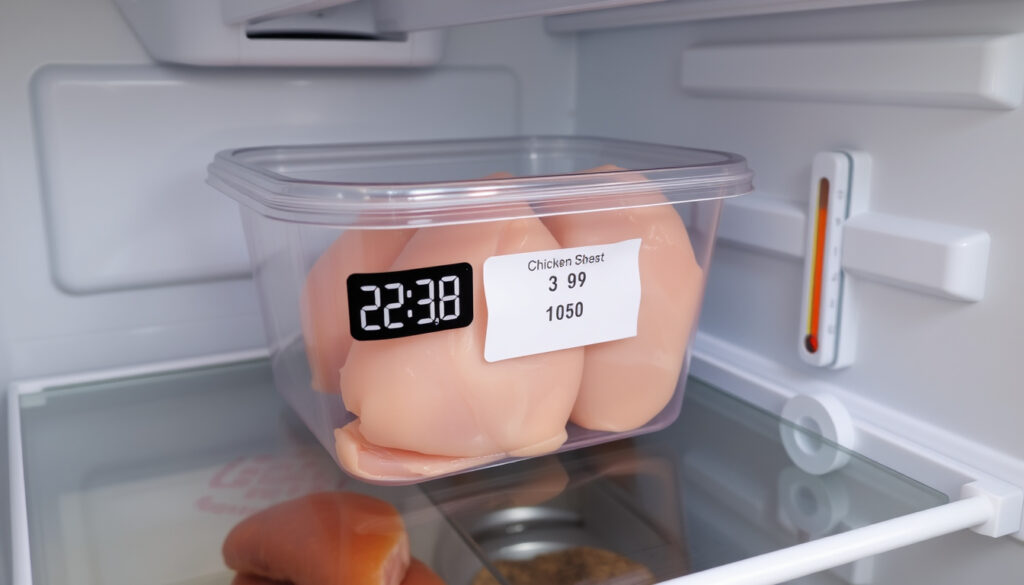
How Long Does Chicken Last in the Fridge? A Complete Guide
You open the fridge, see that pack of chicken you bought a few days ago, and a familiar question pops up: is it still safe to eat? The answer depends on a few specific rules — and one of them might surprise you: according to the FoodSafety.gov cold food storage chart (federal storage guide), raw chicken should be cooked or frozen within 1 to 2 days when the fridge is at 40°F or below, and this guide lays out the exact time limits for raw, cooked, and frozen chicken, plus the spoilage signs you should never ignore.
Raw chicken in fridge (USDA): 1–2 days at 40°F or below ·
Cooked chicken in fridge: 3–4 days ·
Chicken in freezer (raw): Up to 9 months for best quality ·
Chicken in freezer (cooked): 2–6 months ·
Chicken left out at room temp: Max 2 hours (1 hour if above 90°F)
Quick snapshot
- Raw chicken: 1–2 days in fridge at ≤40°F (FoodSafety.gov (U.S. cold storage chart))
- Cooked chicken: 3–4 days under same conditions (FoodSafety.gov)
- Bacterial growth (Salmonella, Campylobacter) accelerates above 40°F (USDA FSIS poultry guidelines)
- Spoilage signs: slime, off odor, color change (USDA Safe Storage of Chicken)
- Whether a perfectly cold fridge (33°F) can safely extend the 2-day raw chicken window.
- The exact impact of repeated opening/closing on shelf life.
- How often consumers misinterpret “sell-by” dates as safety indicators.
- Raw chicken: use or freeze within 2 days of refrigeration at 40°F (USDA FSIS)
- Cooked chicken: refrigerate within 2 hours of cooking, eat within 3–4 days (USDA leftovers safety)
- When in doubt, throw it out – never taste to check. (USDA FSIS)
- Freeze raw chicken by day 2 if you won’t cook it. (FDA food storage guidance)
- Cook and refrigerate leftovers within 2 hours. (FDA food storage guidance)
- Check fridge temperature – it should be 40°F or below (FDA food storage guidance)
Here is a quick reference of key storage parameters from USDA and FDA guidelines.
| Storage parameter | Recommended limit |
|---|---|
| Safe fridge temp | 40°F (4°C) or lower |
| Raw chicken max fridge time | 2 days |
| Cooked chicken max fridge time | 4 days |
| Freezer temp | 0°F (-18°C) or lower |
| Raw chicken freezer shelf life (quality) | Up to 9 months |
| Cooked chicken freezer shelf life | 2–6 months |
| Room temperature danger zone | 40°F – 140°F |
| Max out-of-fridge time | 2 hours (1 hour if above 90°F) |
How long does chicken last in the fridge?
Whether raw or cooked, the clock starts ticking the moment chicken enters the refrigerator. The USDA Food Safety and Inspection Service (federal poultry safety authority) sets clear maximums: raw whole or cut chicken stays safe for 1–2 days at 40°F, while cooked chicken lasts 3–4 days.
How long does chicken last in the fridge uncooked?
- Raw chicken (whole, pieces, ground): 1–2 days in the fridge at ≤40°F (FoodSafety.gov (U.S. cold storage chart)).
- After that, bacterial growth accelerates significantly — especially for Salmonella and Campylobacter, which cause foodborne illness.
- The CDC (national disease control agency) notes that Salmonella symptoms – diarrhea, fever, cramps – typically appear 6 hours to 6 days after infection.
How fridge temperature affects shelf life
- The safe limit is 40°F (4°C) or below, per the U.S. FDA (food safety regulator).
- If your fridge runs warmer – say 42°F – the shelf life shortens. Even 2°F above the threshold can double bacterial growth rates.
- Keep a fridge thermometer on the middle shelf for accurate readings.
The pattern: the 2-day raw chicken window is not a suggestion – it’s the safety ceiling for any refrigerator running at the proper temperature. A warmer fridge shrinks that window further.
How long does cooked chicken last in the fridge?
Cooked chicken has a longer – but still limited – fridge life. The USDA FSIS (food safety authority for meat and poultry) says leftovers should be refrigerated within 2 hours of cooking and used within 3–4 days.
Leftover chicken storage tips
- Divide large portions into shallow airtight containers – they cool faster and more evenly.
- Store on a shelf, not the door, where temperature fluctuates.
- Label with date – it’s too easy to forget when you cooked it.
How to reheat safely after storage
- Reheat cooked chicken to an internal temperature of 165°F (74°C), as recommended by the USDA FSIS cooking guidelines.
- Use a food thermometer to check the center of the thickest piece.
- Only reheat what you’ll eat – avoid cooling and reheating multiple times.
The implication: cooked chicken is a short-term convenience, not a long-term fridge staple. Day 4 is the limit, not a target.
Is raw chicken ok in the fridge for 5 days?
The short answer is no – not by official standards. The USDA FSIS (federal meat and poultry inspector) draws the line at 2 days for raw chicken. But what about a really cold fridge?
Is 6 days too long for raw chicken?
Yes, 6 days far exceeds the USDA guideline of 1–2 days. The risk of pathogenic bacteria is high, even if the chicken looks fine.
Can I eat chicken after 7 days in the fridge?
No, 7 days is well beyond the safe window. The USDA does not support any length beyond 2 days for raw chicken.
What the USDA says
- 1–2 days maximum – no exceptions mentioned for lower temperatures or vacuum packaging.
- The agency bases its guidance on quality and safety, assuming a 40°F fridge that may be opened several times a day.
Risk factors beyond the 2-day window
- After day 2, even if the chicken looks and smells fine, pathogenic bacteria may have multiplied to unsafe levels.
- Some sources, like Springer Mountain Farms (poultry producer), summarise the USDA rule as 1–2 days for raw chicken and 3–4 for cooked, confirming no safe 5-day window.
- If the chicken was previously frozen and then thawed in the fridge, the clock doesn’t restart – use it within 1–2 days of thawing.
The catch: a fridge at 33°F might slow bacterial growth enough to stretch the window, but no official data supports a 5-day claim for raw chicken. The risk is not worth the guess.
How to tell if chicken has gone bad?
When in doubt, trust your senses – but not your taste buds. The USDA Safe Storage of Chicken (federal poultry guidance) lists three reliable signs of spoilage.
Visual signs
- Color change: fresh raw chicken is pinkish; gray, greenish, or dull patches indicate spoilage.
- Mold spots: any fuzzy growth is a definitive “throw away” signal.
Smell test
- Spoiled chicken has a sour, ammonia-like, or sulfurous odor. Fresh chicken has little to no smell.
- Even a faint off smell is enough cause to discard it.
Texture changes
- A slimy or sticky film on the surface – even after rinsing (though you shouldn’t rinse poultry, per USDA FSIS (don’t wash chicken warning)).
- Excessive liquid in the packaging is not a spoilage sign, but if accompanied by odor or slime, toss it.
Why this matters: visual and smell checks are your last line of defense. If chicken passes these tests but is past the safe storage date, trust the clock, not the colour.
How long can chicken sit out?
Raw or cooked chicken should never sit at room temperature for more than 2 hours. The USDA FSIS (food safety guidance on leftovers) sets this hard limit because bacteria multiply rapidly in the “danger zone” of 40°F–140°F.
The 2-hour rule
- Perishable foods – chicken included – must be refrigerated or frozen within 2 hours of cooking or purchasing.
- If the chicken was part of a meal, set a timer. It’s easy to forget while eating.
Hot weather exception (1 hour)
- When the ambient temperature exceeds 90°F (e.g., a summer picnic or a hot kitchen), the safe window shrinks to 1 hour.
- After that, bacterial counts can double every 20 minutes.
The trade-off: the 2-hour rule is based on worst-case fast growth of Staphylococcus aureus and Bacillus cereus. Even if the chicken looks fine after 3 hours, the risk of toxin production is too high to take a chance.
Home cooks face a simple trade-off: the 2-day rule for raw chicken is not negotiable, but freezing buys you months of flexibility. The real risk is not the fridge – it’s the counter.
Pros and cons of following USDA storage guidelines
Upsides
- Reduces risk of Salmonella and Campylobacter infection (CDC (Salmonella symptoms))
- Keeps chicken at best quality – texture and flavour degrade after time limits
- Prevents cross-contamination from raw chicken juices (USDA FSIS (storage separation))
Downsides
- Requires more frequent grocery trips for fresh poultry
- Freezer space needed if you buy in bulk
- Thawing takes planning – overnight in fridge is best, not countertop
The implication: following guidelines reduces risk but requires planning ahead.
Step-by-step guide to safe chicken storage
- Check fridge temperature – install a thermometer and confirm 40°F or below (FDA (fridge temperature recommendation)).
- Store raw chicken on the lowest shelf – in a container or on a plate to prevent juices from dripping onto other foods (USDA FSIS (raw poultry storage)).
- Do not wash raw chicken – rinsing splashes bacteria onto sink and counter surfaces (USDA FSIS Don’t Wash Your Chicken).
- Cook or freeze within 2 days of purchase (raw) or within 4 days (cooked).
- Refrigerate leftovers within 2 hours of cooking – shallow containers speed cooling (USDA FSIS leftovers).
- Use a food thermometer to reheat leftovers to 165°F (USDA FSIS cooking chart).
If you’ve got leftover chicken that needs using up quickly, a Chicken Pot Pie Casserole – Easy 45-Min Family Dinner can help you turn it into a meal before day 4.
What we know – and what’s still fuzzy
Confirmed facts
- USDA FSIS guidelines: raw chicken 1–2 days, cooked 3–4 days (USDA FSIS safe storage).
- Bacterial growth (Salmonella, Campylobacter) accelerates above 40°F (CDC (pathogen data)).
- Spoilage signs: slime, off odor, color change (USDA FSIS safe storage).
What remains unclear
- Whether a perfectly cold fridge (33°F) can safely extend the 2-day raw chicken window.
- The exact impact of repeated opening/closing on shelf life.
- How often consumers misinterpret “sell-by” dates as safety indicators.
The pattern: official guidelines are clear, but real-world variability introduces uncertainty.
Key expert perspectives
Raw poultry should be cooked or frozen within 1 to 2 days when stored at 40°F or below. Cooked poultry can be kept in the refrigerator for 3 to 4 days at the same temperature.
FoodSafety.gov (U.S. government cold food storage chart)
Poultry should be cooked to a safe minimum internal temperature of 165°F (74°C). Use a food thermometer to be sure.
USDA Food Safety and Inspection Service (cooking guidelines)
Salmonella infection usually causes diarrhea, fever, and stomach cramps. Symptoms start 6 hours to 6 days after infection and most people recover without treatment.
Centers for Disease Control and Prevention (Salmonella page)
These three authorities – FoodSafety.gov, USDA FSIS, and the CDC – provide the core safety benchmarks that anyone storing chicken should rely on. Their guidance is consistent: time limits are based on bacterial growth curves, not quality alone.
Summary
Knowing how long chicken lasts in the fridge means respecting the 2-day limit for raw and the 4-day limit for cooked – and never trusting the clock over your senses when spoilage signs appear. Freezing is your best backup for raw chicken you can’t use in time. For home cooks, the choice is clear: stick to the 2-day rule, or freeze it – there’s no safe shortcut.
Related reading: **Chicken Pot Pie Casserole – Easy 45-Min Family Dinner**
For precise recommendations, refer to the USDA guidelines on chicken storage which outline safe refrigerator times for both raw and cooked chicken.
Frequently asked questions
Can I freeze chicken to extend its fridge life?
Yes. Freezing raw chicken at 0°F or below halts bacterial growth. For best quality, freeze raw whole chicken up to 12 months and raw pieces up to 9 months (FoodSafety.gov cold storage chart). Once thawed in the fridge, use within 1–2 days.
What’s the best way to store raw chicken in the fridge?
Keep raw chicken in its original packaging or a sealed container on the lowest shelf to prevent juices from dripping on other foods (USDA FSIS at-risk consumers guide). Do not wash it before storing.
How do I safely defrost frozen chicken?
The safest methods are in the refrigerator (plan ahead – it takes 24 hours per 5 pounds), in cold water (change water every 30 minutes), or microwave (cook immediately after). Never thaw on the counter (USDA FSIS safe storage).
Can I cook chicken that smells a little but looks fine?
No. A faint sour or ammonia smell suggests spoilage bacteria have multiplied even if visual signs are not yet obvious. Discard it (USDA FSIS safe storage).
How long does chicken salad (with mayo) last in the fridge?
Chicken salad containing mayonnaise should be eaten within 3–4 days when kept at 40°F or below. The added ingredients do not extend shelf life beyond the cooked chicken limit.
Is it safe to eat chicken left out overnight if it was cooked?
No. The USDA rule is 2 hours at room temperature (1 hour above 90°F). Overnight far exceeds that window, and bacterial toxins may have formed even if the chicken looks normal (USDA FSIS leftovers).
What temperature should my refrigerator be for poultry?
Set your fridge to 40°F (4°C) or below. Use an appliance thermometer to verify – many fridge dials are inaccurate (FDA food storage guidance).
Can marinating chicken extend its fridge shelf life?
No. Marinating does not stop bacterial growth or extend the safe storage window. Always keep marinating chicken in the fridge and follow the same time limits: 1–2 days for raw, 3–4 days for cooked.
The takeaway: always follow the safest limit – the 2-day rule for raw chicken.
More related posts
 Abducted in Plain Sight: Key Facts & Unanswered Questions
 We Were Liars Book: Complete Guide to the Series & Twist
 Pasta e Fagioli Soup: Ingredients, Tips & Mistakes
 70-Yard Field Goal: Why Cam Little’s Kick Won’t Count
 George W. Bush: 43rd President, 9/11, and Key Questions
 Where Is 21 Savage From? Birthplace and Background
 Fresh Pet Dog Food: Reviews, Vet Advice & Buying Guide