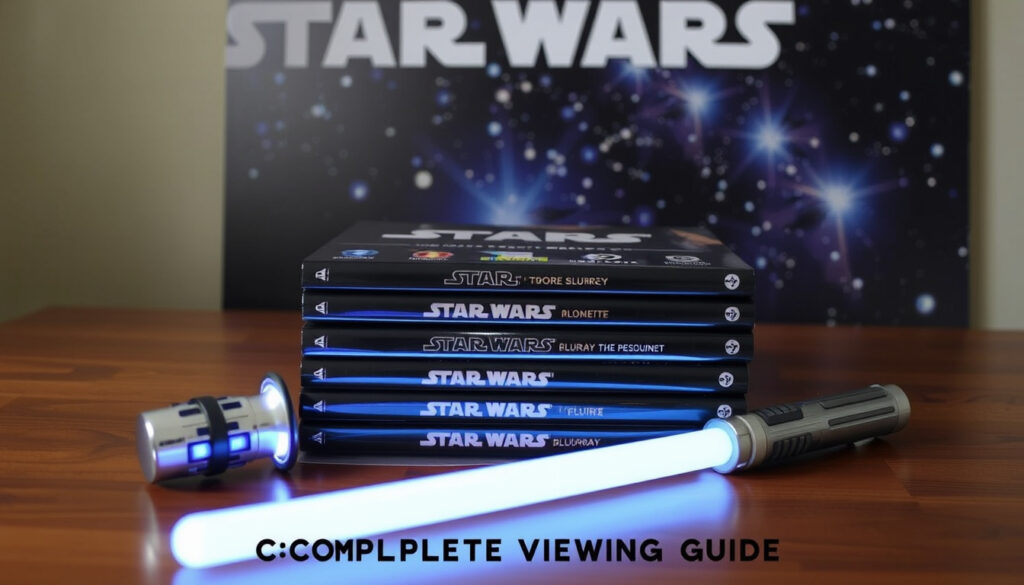
Star Wars in Order: The Complete Viewing Guide (2026)
Few movie franchises spark as much debate among newcomers as this one — not about which film is best, but about which one to press play on first. With 11 theatrical films, five live-action series, and multiple animated shows spread across four decades, the galaxy far, far away can feel more overwhelming than exciting. This guide cuts through the noise, grounded in the official StarWars.com viewing guide and box-office data, so you can decide whether release order, chronological order, or the machete sequence suits your first watch.
Theatrical films released (as of 2026): 11 ·
Live-action series currently streaming: 5 ·
Animated series completed or ongoing: 4 ·
Total runtime of the nine-episode Skywalker Saga: ~24 hours ·
Year the first film premiered: 1977 ·
Year the latest film (Episode IX) debuted: 2019
Quick snapshot
- George Lucas wrote and directed the original trilogy and the prequel trilogy (StarWars.com (official Lucasfilm guide)).
- Disney acquired Lucasfilm in 2012 and produced the sequel trilogy (Rotten Tomatoes Editorial (film release authority)).
- All 11 theatrical films are available on Disney+ (StarWars.com (official streaming guide)).
- Future theatrical release schedule after 2026 has not been officially announced by Disney (Rotten Tomatoes Editorial (film release tracker)).
- The exact viewing order for video games depends on personal story preference (The Popverse (gaming & canon timeline analysis)).
- 1977: A New Hope launches the franchise (Rotten Tomatoes Editorial (release dates)).
- 2019: The Rise of Skywalker ends the Skywalker Saga (Rotten Tomatoes Editorial (release dates)).
- 2026: The Mandalorian and Grogu hits theaters May 22 (Rotten Tomatoes Editorial (upcoming film)).
- May 22, 2026: The Mandalorian and Grogu theatrical release (Rotten Tomatoes Editorial (confirmed date)).
- 2027: Star Wars: Starfighter scheduled for May 28 (Rotten Tomatoes Editorial (upcoming film)).
- No further live-action series dates confirmed beyond current slate (Space.com (franchise timeline roundup)).
Six data points, one takeaway: the franchise spans 49 years of storytelling, and the order you choose reshapes the narrative experience.
| Metric | Value |
|---|---|
| First Star Wars film released | A New Hope (Episode IV) – May 25, 1977 (Rotten Tomatoes Editorial) |
| Most recent theatrical film | The Rise of Skywalker (Episode IX) – Dec 20, 2019 (Rotten Tomatoes Editorial) |
| Number of live-action series | 5 (The Mandalorian, The Book of Boba Fett, Obi-Wan Kenobi, Andor, Ahsoka) (StarWars.com) |
| Total box office of the franchise | Over $10 billion worldwide (Rotten Tomatoes Editorial) |
What is the correct order to watch Star Wars movies and shows?
Three main viewing orders compete for a first-time viewer’s attention. Each changes how reveals land and how the saga’s emotional beats hit.
Release order for first-time viewers
- Start with Episode IV (1977), then V, VI, I, II, III, VII, VIII, IX (StarWars.com (official release-order guide)).
- Preserves the original storytelling surprise of Darth Vader’s parentage reveal (StarWars.com (viewing rationale)).
- Includes anthology films Rogue One (2016) and Solo (2018) after Episode VII and before Episode VIII (Rotten Tomatoes Editorial).
Chronological order for the full saga
- Begins with The Acolyte (2024), then Episode I (1999), II, III, Solo, Rogue One, IV, V, VI, VII, VIII, IX (Space.com (chronological placement guide)).
- Requires watching 11 films and multiple series in in-universe timeline sequence.
- Ideal for rewatchers who already know the plot twists (StarWars.com).
Viewing guide for newcomers from StarWars.com
- StarWars.com explicitly recommends release order for new viewers (StarWars.com (official recommendation)).
- Their guide lists films and series in release sequence, from A New Hope through The Mandalorian and Grogu (StarWars.com).
- Chronological order is offered as an alternative for those already familiar with the story.
First-time viewers risk major spoilers if they start with Episode I: the reveal that Darth Vader is Luke’s father — a cornerstone of pop culture — is only shocking if you meet the prequels after the original trilogy.
Bottom line: Release order is the safest bet for newcomers. Fans who want the full in-universe experience should pick chronological order for a rewatch. First-time viewers: choose release order or risk losing the saga’s biggest twist.
What are the 9 main Star Wars films in order?
The Skywalker Saga is split into three trilogies released over 42 years. Here is the episode numbering and release timeline.
The Skywalker Saga episode numbering
- Prequel trilogy: Episodes I–III (1999, 2002, 2005) (Rotten Tomatoes Editorial).
- Original trilogy: Episodes IV–VI (1977, 1980, 1983) (Rotten Tomatoes Editorial).
- Sequel trilogy: Episodes VII–IX (2015, 2017, 2019) (Rotten Tomatoes Editorial).
Release year and episode title for each film
- Star Wars: Episode IV – A New Hope (May 25, 1977) (Rotten Tomatoes Editorial).
- Star Wars: Episode V – The Empire Strikes Back (May 21, 1980).
- Star Wars: Episode VI – Return of the Jedi (May 25, 1983).
- Star Wars: Episode I – The Phantom Menace (May 19, 1999).
- Star Wars: Episode II – Attack of the Clones (May 16, 2002).
- Star Wars: Episode III – Revenge of the Sith (May 19, 2005).
- Star Wars: Episode VII – The Force Awakens (Dec 18, 2015).
- Star Wars: Episode VIII – The Last Jedi (Dec 15, 2017).
- Star Wars: Episode IX – The Rise of Skywalker (Dec 20, 2019) (all from Rotten Tomatoes Editorial).
The pattern: Lucasfilm released the middle of the story first, then the beginning, then the end. That choice continues to define the debate over viewing order.
Why is the recommended viewing order 4, 5, 6, 1, 2, 3?
The machete order explanation
- Sequence: Episode IV, V, II, III, VI — skipping Episode I entirely (The Popverse (viewing order analysis)).
- Skips The Phantom Menace to avoid the pacing drag and to keep the Darth Vader reveal intact after Empire Strikes Back.
- Places Attack of the Clones and Revenge of the Sith as a flashback between Empire and Jedi.
How release order prevents spoilers
- Episode IV was released first: viewers meet Luke, Leia, and Vader without any knowledge of Anakin’s past (StarWars.com (narrative logic)).
- The “I am your father” reveal in Episode V (1980) is one of cinema’s most famous twists — watching chronologically ruins it.
- Release order lets the audience experience the story as it was originally crafted, with each new film expanding the universe.
Pure release order (4-5-6-1-2-3-7-8-9) can feel jarring when jumping from the special-effects revolution of 1983 to the digital prequels of 1999. The machete order mitigates this by treating the prequels as a single flashback arc.
Bottom line: The 4-5-6-1-2-3 sequence preserves the trilogy’s storytelling magic while integrating the prequels where they function as an extended flashback. First-time viewers: stick with release order; experienced fans can experiment with machete.
In what order should I play Star Wars video games?
The Star Wars gaming universe spans thousands of years of in-universe history. Here’s how the major titles align with the film timeline.
Chronological timeline of major Star Wars games
- Star Wars: Knights of the Old Republic (2003) — set 4,000 years before the films (The Popverse (gaming placement)).
- Star Wars: The Force Unleashed (2008) — bridges Episode III and Episode IV (Space.com (timeline reference)).
- Star Wars Jedi: Fallen Order (2019) and Star Wars Jedi: Survivor (2023) — occur between Episode III and Episode IV (The Popverse).
- Star Wars: Squadrons (2020) — after Episode VI.
Best games for story alignment with the films
- For full narrative coherence, play Knights of the Old Republic before the prequels, then Jedi: Fallen Order after Episode III, then The Force Unleashed before Episode IV.
- The Battlefront series is anthology-based and can be played at any point.
- No official canon viewing order for games exists — the StarWars.com guide covers only films and series.
What is the chronological order of all Star Wars films?
Complete chronological list of the 11 theatrical films
- Star Wars: Episode I – The Phantom Menace (1999)
- Star Wars: Episode II – Attack of the Clones (2002)
- Star Wars: Episode III – Revenge of the Sith (2005)
- Solo: A Star Wars Story (2018) — occurs after Episode III
- Rogue One: A Star Wars Story (2016) — leads directly into Episode IV
- Star Wars: Episode IV – A New Hope (1977)
- Star Wars: Episode V – The Empire Strikes Back (1980)
- Star Wars: Episode VI – Return of the Jedi (1983)
- Star Wars: Episode VII – The Force Awakens (2015)
- Star Wars: Episode VIII – The Last Jedi (2017)
- Star Wars: Episode IX – The Rise of Skywalker (2019)
Placement of standalone films (Rogue One, Solo)
- Rogue One ends minutes before A New Hope begins (Space.com (chronological alignment)).
- Solo takes place roughly ten years before A New Hope, after the prequel trilogy (Space.com (positioning)).
- Both are included in the chronological watch order on Disney+.
The implication: a chronological marathon pushes Rogue One into the middle, and the tonal shift from dark war drama to classic adventure can be abrupt.
If you start with The Acolyte (2024) and watch chronologically, you’ll see 132 years of in-universe history unfold linearly — but the original trilogy’s magic is designed to be discovered in release order. The trade-off is between narrative surprise and timeline completeness.
Timeline of key Star Wars releases
- 1977 – A New Hope launches the franchise (Rotten Tomatoes Editorial).
- 1980 – The Empire Strikes Back released.
- 1983 – Return of the Jedi concludes original trilogy.
- 1999 – The Phantom Menace begins prequel trilogy.
- 2015 – The Force Awakens starts sequel trilogy.
- 2019 – The Rise of Skywalker ends Skywalker Saga.
What we know and what’s still uncertain
Confirmed facts
- George Lucas wrote and directed the original trilogy and prequel trilogy (StarWars.com).
- Disney acquired Lucasfilm in 2012 and produced the sequel trilogy (Rotten Tomatoes Editorial).
- All 11 theatrical films are available on Disney+ (StarWars.com).
What’s unclear
- Future theatrical release schedule after 2026 has not been officially announced by Disney (Rotten Tomatoes Editorial).
- The exact viewing order for video games depends on personal story preference (The Popverse).
Expert perspectives on the viewing order
The official guide recommends release order for new viewers so they can experience the story the way it was originally told — with the reveals intact.
— StarWars.com editorial team (official Lucasfilm guide)
Watching chronologically offers a binge-friendly marathon that highlights the saga’s interconnectedness, but it spoils the iconic twist.
— Rotten Tomatoes Editorial (film analysis team)
Both sources agree on one thing: the “correct” order depends on what you value — surprise or timeline continuity.
For those looking to experience the galaxy far, far away for the first time or revisit it with fresh eyes, this guide to watching the saga breaks down both chronological and release order approaches.
Frequently asked questions
How many Star Wars movies are there including spin-offs?
There are 11 theatrical films — nine episodes of the Skywalker Saga plus two anthology films (Rogue One and Solo). The Mandalorian and Grogu releases in May 2026, bringing the total to 12 (Rotten Tomatoes Editorial).
Is it better to watch Star Wars in chronological or release order?
For first-time viewers, release order (4,5,6,1,2,3,7,8,9) is recommended to preserve narrative surprises. Chronological order is better for rewatches or fans who already know the story (StarWars.com).
Does the Star Wars timeline include the animated series?
Yes. StarWars.com includes The Clone Wars, Rebels, Resistance, and Tales of the Jedi in both release and chronological guides. The animated canon adds dozens of hours of storytelling (StarWars.com).
Are the Star Wars movies available on Netflix?
No. As of 2026, all Star Wars films stream exclusively on Disney+ in most regions (StarWars.com).
What is the machete order and why is it recommended?
Machete order (4,5,2,3,6) skips Episode I to improve pacing and keep Darth Vader’s reveal intact. It treats Episodes II and III as a flashback between Empire and Jedi. Some fans add Rogue One after Revenge of the Sith (The Popverse).
Do I need to watch the Star Wars series before the movies?
No. The series expand the universe but are not required for understanding the Skywalker Saga. For a minimal watch order, stick to the 9 episodes. Series like Andor and The Mandalorian can be enjoyed after the films.
What is the correct order to watch Star Wars in 2026?
With The Mandalorian and Grogu releasing in May 2026, the recommended release order adds it after Episode IX. Chronological order places it after Return of the Jedi and before Episode VII (Rotten Tomatoes Editorial).
For the first-time viewer deciding where to start, the choice is clear: release order protects the story’s biggest moments. For the completionist who wants to see the galaxy in linear time, chronological order is the full buffet. Either way, you’re in for 42 years of storytelling — just don’t let the debate keep you from hitting play. You can always revisit the Abby Jimenez Books in Order for other franchises, or check Current Movies in Theaters for a break from the galaxy far, far away.
More related posts
 Sunrisers Hyderabad vs Gujarat Titans Timeline: IPL History
 Steven Yeun Movies and TV Shows: Full Career Guide
 Jennifer Tilly Movies and TV Shows: Complete Guide & Net Worth
 The Watsons Go to Birmingham Movie: True Story, Cast & Where to Watch
 Insurance Premium: What It Is, Examples & How It Works
 WYD Meaning in Text: What It Stands For and How to Use It
 Canker Sore vs Oral Cancer: How to Tell the Difference
 Partidos de Al Nassr 2025-26: Schedule, Results & CR7 Stats