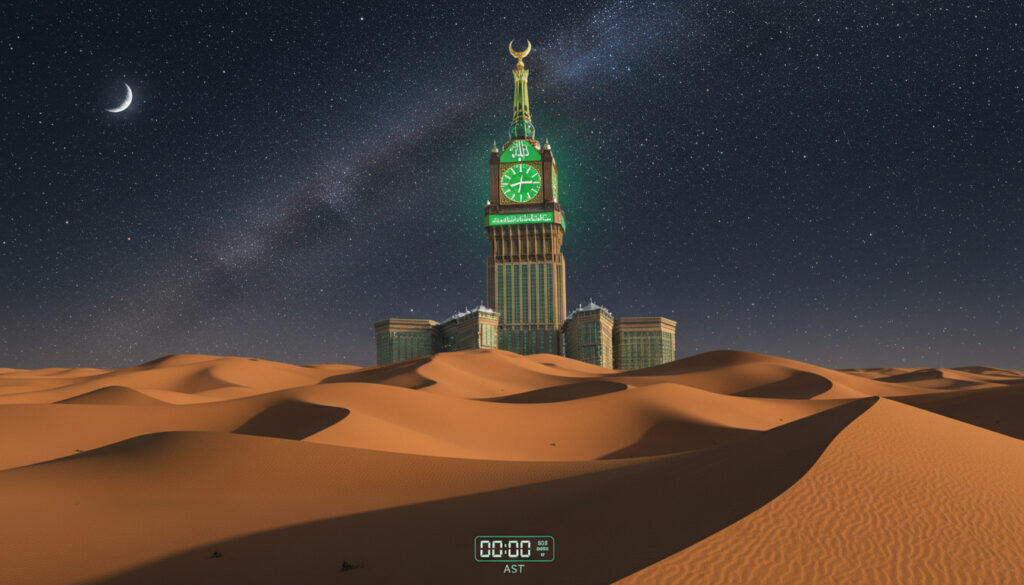
Time in Saudi Arabia – Arabia Standard Time Guide
Saudi Arabia operates under a single, unified time zone that remains constant throughout the year. The Kingdom follows Arabia Standard Time (AST), positioned exactly three hours ahead of Coordinated Universal Time (UTC+3), with no daylight saving adjustments.
Whether checking the hour in Riyadh, Jeddah, or Mecca, the time remains identical across all regions. This consistency simplifies coordination for the nation’s 35 million residents and visitors navigating business or religious schedules.
Understanding Saudi Arabia’s temporal standards proves essential for international communications, travel planning, and observing Islamic prayer times that follow solar calculations rather than clock adjustments.
What Time Is It in Saudi Arabia Right Now?
UTC+3 year-round
Arabia Standard Time (AST)
Not observed
Riyadh, Jeddah, Mecca (all same zone)
- Saudi Arabia maintains a single time zone nationwide without regional variations.
- The Kingdom abolished daylight saving time transitions, with the last change occurring in 1947.
- All major urban centers including Riyadh, Jeddah, and Mecca synchronize to identical local time.
- The UTC+3 offset aligns Saudi Arabia with neighboring Gulf states including Bahrain, Qatar, and Kuwait.
- Geographic positioning near the equator minimizes seasonal daylight fluctuations, reducing practical need for clock adjustments.
- The IANA time zone database designates the region as Asia/Riyadh.
| Parameter | Specification |
|---|---|
| UTC Offset | +3 hours |
| Time Zone Name | Arabia Standard Time (AST) |
| IANA Identifier | Asia/Riyadh |
| DST Observance | None |
| Last DST Transition | 1947 |
| Major Metropolitan Areas | Riyadh, Jeddah, Mecca, Medina |
| Population Covered | 35 million+ |
| Regional Alignment | Bahrain, Qatar, Kuwait, Iraq, Jordan |
Current local time remains synchronized across the Kingdom’s vast geography, from the Red Sea port of Jeddah to the eastern industrial zones. Verification sources confirm uniform application of UTC+3 nationwide.
What Time Zone Does Saudi Arabia Use?
Saudi Arabia utilizes Arabia Standard Time (AST), recognized internationally as UTC+3. This designation places the Kingdom three hours ahead of Greenwich Mean Time, sharing the same offset with neighboring countries across the Arabian Peninsula.
Understanding Arabia Standard Time
AST represents a consistent temporal standard unaffected by seasonal variations. The zone covers approximately 2.15 million square kilometers, encompassing diverse landscapes from coastal plains to desert interiors while maintaining temporal unity.
The Asia/Riyadh IANA Designation
The Internet Assigned Numbers Authority (IANA) registers Saudi Arabia under the identifier “Asia/Riyadh.” This classification appears in global time databases, ensuring software systems and scheduling applications reference the correct offset. Technical specifications indicate this designation applies uniformly without daylight saving modifications.
Unlike vast countries spanning multiple zones, Saudi Arabia maintains identical local time from the Red Sea coast to the Persian Gulf border. This uniformity eliminates confusion for domestic travel and scheduling.
Does Saudi Arabia Observe Daylight Saving Time?
The Kingdom does not currently observe daylight saving time. Clocks remain fixed year-round, eliminating the biannual adjustments common in temperate regions.
Historical DST Transitions
Saudi Arabia experimented with daylight saving time in earlier decades. The last recorded transition occurred in 1947, after which the nation maintained standard time continuously. Historical records indicate no seasonal clock changes for over seven decades.
Geographic Factors
The country’s equatorial latitude results in minimal seasonal daylight variation throughout the year. Unlike regions at higher latitudes where summer days extend significantly, Saudi Arabia experiences relatively consistent daylight duration, reducing practical benefits from clock adjustments.
What Is the Time Difference Between Saudi Arabia and Other Countries?
International coordination requires attention to significant temporal gaps. Saudi Arabia (UTC+3) operates ahead of major Western economies and aligns closely with Middle Eastern neighbors.
| Region | Time Difference |
|---|---|
| US Eastern Standard Time (UTC-5) | 8 hours behind |
| US Pacific Standard Time (UTC-8) | 11 hours behind |
| UK Greenwich Mean Time (UTC+0) | 3 hours behind |
| Egypt (UTC+2) | 1 hour behind |
| Greece (UTC+2/3) | Up to 2 hours behind |
Conversion tables facilitate scheduling across these zones. When planning international meetings from the Kingdom, midday in Riyadh corresponds to early morning hours on the United States East Coast.
Business communications between Saudi Arabia and the United States require careful scheduling. When it is 10:00 AM in Riyadh, it is 2:00 AM in New York during standard time.
The abbreviation “AST” may refer to Atlantic Standard Time (UTC-4) in North American contexts. Always verify context when scheduling across regions to avoid missed appointments.
Travelers coordinating activities across continents may find resources like Best Places to Watch Whales – Top Global Destinations and Seasons useful for understanding how time differences affect seasonal observation schedules in various regions.
When Did Saudi Arabia Establish Its Current Time Standards?
- Pre-1947: Experimental periods of daylight saving time observed during earlier decades.
- 1947: Final transition away from seasonal time changes; permanent standard time adopted.
- Current Era: Continuous operation under fixed Arabia Standard Time (UTC+3).
Regional standards confirm Saudi Arabia maintains alignment with the Gulf Cooperation Council’s temporal practices.
What Is Certain About Saudi Time Standards?
| Established Information | Information Requiring Verification |
|---|---|
| UTC+3 offset applies nationwide without exception | Specific government department business hours |
| No daylight saving time observed since 1947 | Daily Islamic prayer time calculations by city |
| Uniform time across Riyadh, Jeddah, and Mecca | Historical details of pre-1947 time policies |
| IANA designation: Asia/Riyadh | Private sector operating schedules |
How Does Saudi Arabia’s Time Zone Affect Daily Life?
The fixed time zone simplifies domestic logistics. Trains, flights, and telecommunications operate on a single temporal reference regardless of origin or destination within the Kingdom. This uniformity eliminates the confusion faced by travelers in countries spanning multiple zones.
Islamic prayer times present a unique consideration. While clock time remains constant, the five daily prayers (Fajr, Dhuhr, Asr, Maghrib, Isha) follow solar position calculations that vary by location and season. Residents typically consult specialized prayer time applications that account for local geographic coordinates rather than relying solely on standard clock time.
Business operations generally follow patterns common in the region, though specific hours vary by sector. Government and commercial activities typically occur during daylight hours, with adjustments made seasonally to accommodate prayer schedules and climate conditions rather than clock changes.
What Do Official Standards Say?
Saudi Arabia uses Arabian Standard Time (AST), which is UTC+3 year-round with no Daylight Saving Time (DST) observance.
— Current Time UTC Database
International time standardization bodies recognize the Kingdom’s adherence to fixed UTC+3. Technical references distinguish Arabian Standard Time from similarly abbreviated zones, emphasizing the UTC+3 specification for Middle Eastern contexts.
Why Does Saudi Arabia Maintain a Fixed Time Zone?
The Kingdom’s fixed UTC+3 standard supports economic coordination with Gulf neighbors while eliminating the disruption associated with seasonal clock changes. This stability benefits international business relations, religious observance, and domestic travel logistics across the geographically diverse nation. For those interested in chronological systems across different contexts, exploring The Legend of Zelda – Games in Order and Timeline Guide offers insight into how time and sequence function in entirely different narrative frameworks.
Frequently Asked Questions
What time is it in Jeddah Saudi Arabia right now?
Jeddah follows the same time as all Saudi cities: Arabia Standard Time (UTC+3). This matches Riyadh and Mecca exactly, with no time difference between coastal and inland regions.
What is the time difference between Saudi Arabia and the US?
Saudi Arabia is 8 hours ahead of US Eastern Standard Time and 11 hours ahead of Pacific Standard Time. During US daylight saving time, the difference reduces by one hour.
What are the prayer times in Saudi Arabia by city?
Prayer times vary daily by location and follow solar calculations. While clock time remains UTC+3 nationwide, Fajr, Dhuhr, Asr, Maghrib, and Isha occurrences shift throughout the year. Consult official Saudi religious authorities or the Umm al-Qura calendar for specific schedules.
What are standard business hours in Saudi Arabia?
Government and private sectors typically operate Sunday through Thursday. Specific hours vary, with many offices opening between 8:00-9:00 AM and closing 4:00-5:00 PM, though confirmation from specific organizations is advised as schedules may differ.
Does Saudi Arabia change clocks for daylight saving?
No. Saudi Arabia maintains constant UTC+3 year-round. The last clock change occurred in 1947, and the nation has observed fixed standard time since.
Is the time in Mecca different from Riyadh?
No. Mecca and Riyadh share identical local time under the unified Asia/Riyadh time zone. Both cities observe UTC+3 simultaneously.
More related posts
 Home Depot Facility Davidson County Closure – 108 Layoffs Detailed
 Insurance Premium: What It Is, Examples & How It Works
 How Long Are You Contagious With the Flu – Timeline & When Safe
 Seahawks vs Rams Player Stats: 2026 NFC Championship
 WYD Meaning in Text: What It Stands For and How to Use It
 ASICS Gel-Nimbus 27: Podiatrist Insights & Model Guide
 Buffy the Vampire Slayer Cast: Members, Replacements & LGBTQ