The Legend of Zelda – Games in Order and Timeline Guide
The Legend of Zelda stands as one of Nintendo’s most enduring franchises, defining the action-adventure genre since its 1986 debut on the NES. Created by Shigeru Miyamoto, the series follows the recurring conflict between Link, Princess Zelda, and the dark lord Ganon across the mythical kingdom of Hyrule, weaving complex narratives involving the Triforce artifacts of Power, Wisdom, and Courage.
Spanning nearly four decades and 19 mainline titles, the franchise has evolved from 2D top-down exploration to revolutionary open-world design. With cumulative sales exceeding 140 million units globally, according to historical sales data, the series continues to influence game development while maintaining strict exclusivity to Nintendo hardware platforms.
Each entry reinvents the core formula while preserving essential mythology: a silent hero, a wise princess, and an eternal struggle against the Triforce of Power.
What Is The Legend of Zelda?
Nintendo (Shigeru Miyamoto)
1986 (NES)
Action-Adventure
140M+ Units
- The timeline splits into three distinct branches following Ocarina of Time
- Link and Zelda reincarnate across eras while retaining core Triforce attributes
- Breath of the Wild revolutionized open-world mechanics upon its 2017 release
- A live-action film adaptation entered development with Sony and Nintendo in 2023
- The series maintains platform exclusivity across Nintendo hardware generations
| Fact | Details |
|---|---|
| Main Protagonist | Link (various incarnations) |
| Royal Figure | Princess Zelda (Wisdom Triforce bearer) |
| Primary Antagonist | Ganon/Ganondorf (Power Triforce bearer) |
| Iconic Weapon | Master Sword |
| Latest Mainline Entry | Tears of the Kingdom (2023) |
| Timeline Structure | Unified past splitting into three branches |
Legend of Zelda Games in Release Order
Nineteen mainline entries comprise the core series, released chronologically across every Nintendo platform from the NES to the Switch. The franchise began with the eponymous The Legend of Zelda in 1986, establishing the foundational top-down exploration mechanics that would define early entries.
The series trajectory shifted permanently with 1998’s Ocarina of Time for Nintendo 64, which introduced 3D action-adventure gameplay to mainstream audiences. Recent entries include Breath of the Wild (2017) and its sequel Tears of the Kingdom (2023), both available on Nintendo Switch, alongside the side-entry Echoes of Wisdom (2024). Complete release chronologies document these evolutions across hardware generations.
How Many Games Exist?
The franchise encompasses 19 mainline releases, excluding spin-offs and remasters. This count includes dual releases such as Oracle of Seasons and Oracle of Ages (2001), which shipped as separate but interconnected Game Boy Color titles.
While original releases remain tethered to their native hardware, Nintendo has remastered several titles for modern systems. Link’s Awakening received a full remake for Switch in 2019, while Skyward Sword HD launched on Wii U and later Switch.
Who Are the Main Characters?
Link
Link serves as the silent protagonist across most entries, bearing the Triforce of Courage. Unlike traditional heroes, Link represents a reincarnating spirit rather than a single individual, with each era featuring a new incarnation—such as the Hero of Time in Ocarina of Time or the Champion in Breath of the Wild. Character analyses detail these distinctions.
Princess Zelda
Zelda carries the Triforce of Wisdom, typically appearing as Hyrule’s reigning princess or its spiritual guardian. Like Link, she reincarnates across timelines, though her role varies from active combatant—as seen in Echoes of Wisdom where she serves as the playable protagonist—to guiding sage.
Ganon and Ganondorf
The series antagonist assumes dual forms: the humanoid Gerudo king Ganondorf and the bestial demon Ganon. Stemming from Demise’s curse in Skyward Sword, this incarnation of the Triforce of Power persists across all three timeline branches, serving as the eternal opposition to Hyrule’s peace.
Understanding the Zelda Timeline
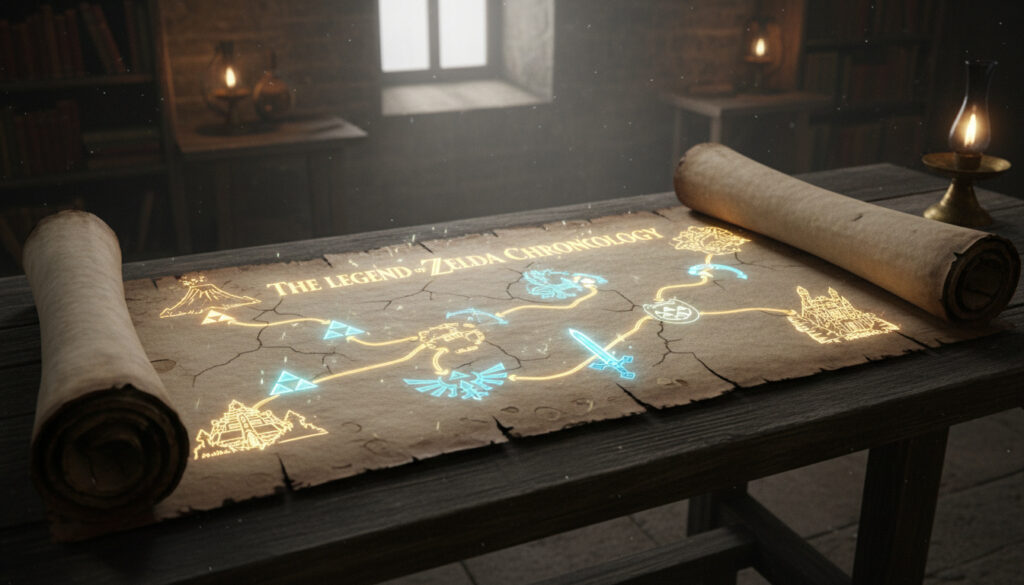
Official chronology establishes Skyward Sword as the series origin, depicting Demise’s curse that binds Link and Zelda to eternal conflict with his reincarnating hatred. The timeline fractures following Ocarina of Time, creating three divergent realities based on Link’s success or failure against Ganondorf.
The Fallen Hero Timeline explores a reality where Link dies fighting Ganondorf, leading to the Imprisoning War and events of A Link to the Past. The Child Timeline follows Link returned to his youth, resulting in Majora’s Mask and Twilight Princess. The Adult Timeline proceeds without Link, flooding Hyrule and yielding The Wind Waker’s Great Sea setting. Fandom documentation provides extensive branch details.
Breath of the Wild and Tears of the Kingdom occupy a distant future where all timeline branches theoretically converge, though Nintendo maintains deliberate ambiguity regarding specific connections.
The official timeline has undergone revisions since its 2011 publication, and Nintendo explicitly preserves creative gaps allowing individual interpretation between specific game connections.
How Did the Series Release Chronologically?
Development history traces distinct technological eras, from 8-bit sprites to open-world physics engines.
- 1986: The Legend of Zelda (NES) establishes the core formula. Wikipedia
- 1987: Zelda II: The Adventure of Link introduces side-scrolling combat. Wikipedia
- 1991: A Link to the Past (SNES) refines the top-down format. Green Man Gaming
- 1998: Ocarina of Time (N64) pioneers 3D action-adventure. Green Man Gaming
- 2017: Breath of the Wild (Switch/Wii U) redefines open-world design. Nintendo
- 2023: Tears of the Kingdom expands vertical exploration and construction mechanics. Nintendo
What Aspects Remain Definitively Established?
| Established Canon | Uncertain Elements |
|---|---|
| Three-branch timeline structure post-Ocarina of Time | Specific placement of Breath of the Wild within converged branches |
| Nintendo’s ownership and platform exclusivity | Exact plot details and release window for the live-action film |
| Shigeru Miyamoto’s role as series creator | Potential Nintendo Switch 2 remaster announcements |
| 140M+ cumulative sales figure | Confirmation of 2025 mainline releases |
Why Does The Legend of Zelda Maintain Cultural Significance?
The franchise’s influence extends beyond commercial success into foundational game design principles. Miyamoto’s childhood explorations of natural landscapes informed the series’ emphasis on discovery and non-linear progression, establishing conventions later adopted by Best Places to Watch Whales – Top Global Destinations and Seasons exploration-based entertainment.
Evolution from 2D tile-based maps to the seamless open world of Breath of the Wild demonstrates Nintendo’s willingness to deconstruct established formulas. This iterative approach—respecting legacy while embracing mechanical innovation—has preserved relevance across hardware generations spanning nearly four decades.
What Do Primary Sources Confirm?
It’s not just about saving the princess. The essence of the series lies in the sense of adventure and discovery.
— Shigeru Miyamoto, Series Creator (Attributed)
Nintendo’s official investor relations documentation confirms sales data exceeding 140 million units globally, positioning the franchise among the industry’s best-selling properties. The company maintains strict development protocols regarding timeline consistency, though individual game directors retain creative flexibility within established lore.
What Defines The Legend of Zelda Today?
The Legend of Zelda represents Nintendo’s premier action-adventure property, characterized by reincarnating heroes, fracturing timelines, and hardware-defining technical achievements. From 1986’s 8-bit origins to 2023’s physics-driven sandbox design, the series maintains narrative coherence across 19 mainline entries while preparing for cinematic expansion. Players seeking hardware assistance for related gaming setups might consult Tree Service Near Me – Costs, Services, Hiring Guide for professional maintenance of gaming environments.
Frequently Asked Questions
Why is it called The Legend of Zelda instead of The Legend of Link?
The title references Princess Zelda’s recurring role as the wise, often magical figure central to Hyrule’s fate, whereas Link represents the player’s silent avatar.
What is Breath of the Wild?
Released in 2017 for Switch and Wii U, this open-world entry broke from traditional dungeon structures, emphasizing physics-based exploration and non-linear progression.
Are there any upcoming Legend of Zelda games confirmed for 2025?
No mainline releases are confirmed for 2025; current focus remains on recent titles including Tears of the Kingdom and Echoes of Wisdom.
How does the timeline split into three branches?
Following Ocarina of Time, the timeline diverges based on Link’s battle outcome: Fallen Hero (defeat), Child (returned to past), and Adult (future without Link).
Is The Legend of Zelda available on Nintendo Switch?
Yes, Breath of the Wild, Tears of the Kingdom, Link’s Awakening remake, Skyward Sword HD, and Echoes of Wisdom are all available on Switch.
What is the status of the live-action Zelda movie?
Sony and Nintendo announced development in 2023 with Wes Ball directing, though specific plot details and release dates remain unconfirmed.
More related posts
 When Does Love Island USA Start 2025? Premiere & How to Watch
 The Roses 2025 Movie: Cast, Streaming, Review & Remake Details
 Daisy Edgar-Jones Facts, Biography & Rumors Debunked
 What Phase is the Moon in Today? Current Guide & Calendar
 University of Florida Acceptance Rate 2025: GPA, Stats & Tips
 Dicks Sporting Good Hours – Weekday, Weekend & Holiday Schedules
 35 Celsius to Fahrenheit: Fever, Conversion & Mental Math
 Did the Government Shut Down? 2025 Shutdown Impact and Aftermath