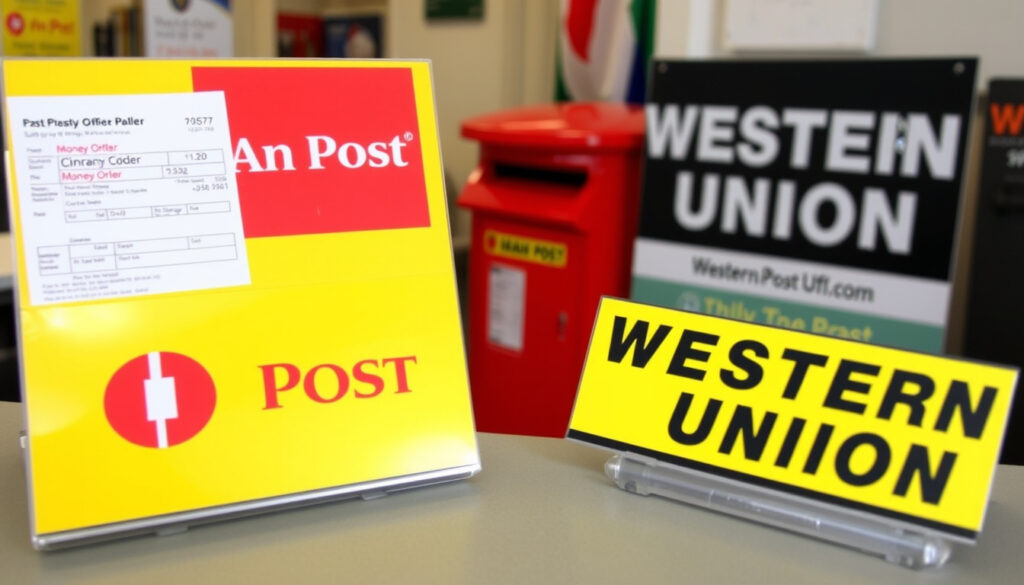
Money Orders Near Me: An Post vs Western Union in Ireland
Paying a bill or sending cash to a relative often comes down to a simple question: where can I get a money order fast, without overpaying? In Ireland, the answer is more nuanced than you might expect, as An Post and Western Union operate side by side at post office counters, each with its own fee structure and limits.
An Post domestic postal money order fee: €2.00–€5.50 · Western Union at An Post fee (€0–€35): €7.50 · Western Union agent locations in Ireland: Over 500 · Maximum single transaction (An Post): €6,000
Quick snapshot
- Proof of name needed for transactions ≥€1,000 (An Post)
- Proof of address + due diligence for ≥€7,500 in 12 months (An Post)
- Supplementary message (1–10 words): €1.50 (An Post)
- Telephone notification: €2.50 (An Post)
- Physical delivery: €10.00 (An Post)
The table below summarises the key facts about money orders in Ireland.
| Label | Value |
|---|---|
| An Post domestic postal money order fee (lowest band) | €2.00 for €0.60–€15 |
| An Post domestic postal money order fee (highest band) | €5.50 for €130.01–€650 |
| Western Union at An Post fee (€0–€35) | €7.50 |
| Western Union at An Post fee (€250.01–€380) | €29.00 |
| Western Union max amount at An Post | €6,000 |
| An Post proof of name threshold | €1,000 single transaction |
| An Post customer due diligence threshold | €7,500 in 12 months |
| Supplementary message fee | €1.50 |
| Telephone notification fee | €2.50 |
Where can I quickly get a money order?
An Post post offices in Ireland
- Every An Post branch offers Postal Money Orders and Western Union transfers. The service is available at the counter during regular post office hours. Fees are based on the amount you send, as published on the An Post website.
- An Post has over 900 post offices nationwide, making it the most accessible option for in-person money orders in Ireland.
Western Union agent locations
- Western Union operates through An Post counters and also through independent agents across Ireland. According to the Western Union fee table, fees vary by channel and location. The network includes over 500 agent locations in Ireland.
- You can send money domestically or internationally, but the fee structure is steeper than a standard postal money order for small amounts.
USPS locations (United States comparison)
- For readers familiar with the US system, USPS money orders are capped at $1,000 per order with a fee of $1.25 for up to $500. This is not available in Ireland, but it’s a common reference point for comparison.
An Post’s Postal Money Order is cheaper for domestic transfers under €130, but Western Union becomes more cost-effective for larger amounts thanks to a flat fee structure. The choice depends on the amount you need to send.
The pattern shows that the cheapest option varies by transfer size, so knowing your amount is key.
What is a money order and how do you fill one out?
What information is needed for a money order?
- A money order is a prepaid payment instrument. You pay the face value plus a fee, and the recipient can cash it or deposit it. To fill one out, you need the payee’s full name, your name and address, and your signature. The An Post service page confirms that proof of name is required for transactions over €1,000.
- Keep the receipt — it’s your only proof of purchase if the money order is lost or stolen.
Step-by-step instructions to fill out a money order
- Go to an An Post counter and request a Postal Money Order (or a Western Union transfer).
- Provide the recipient’s full name and your own details. For amounts over €1,000, you’ll need to show photo ID (passport or driving licence).
- Pay the amount you want to send plus the applicable fee. The clerk will print the money order.
- Sign the money order in the purchaser’s signature field. Do not sign the payee line.
- Fill in the payee’s name on the “Pay to the order of” line. Double-check spelling.
- Hand the money order to the recipient or mail it securely. Keep the receipt for tracking.
A single mistake on the payee name can delay the recipient’s access to funds. The An Post guide stresses that the signature must match the ID you provided.
Attention to detail here prevents delays and extra fees.
Can I get a money order at any bank?
Banks that offer money orders
- Most Irish banks (AIB, Bank of Ireland, Permanent TSB) do not offer money orders as a standard service. Instead, they provide bank drafts or electronic transfers. The only in-person money order option in Ireland is through An Post or Western Union agents.
- In the US, banks like Chase, Bank of America, and Wells Fargo do issue money orders. Fees for non-customers range from $5 to $10.
Requirements for getting a money order at a bank
- If you’re a customer of a US bank, you can typically get a money order at the teller counter. Non-customers may be refused or charged a higher fee. No such option exists at Irish banks.
Fees for bank money orders
- Bank money order fees in the US are typically $5–$10 for non-customers. Some premium account holders may get them free. In Ireland, the only comparable option is a bank draft, which costs about €6.50–€12.50 depending on the bank.
Irish banks have largely phased out over-the-counter money orders. If you need a paper payment instrument, an An Post Postal Money Order is the most accessible and cheapest option for domestic use.
The implication is clear: Irish residents should not rely on banks for in-person money orders.
What is a postal money order in Ireland?
How to get a postal order in Ireland
- Visit any An Post branch. Ask for a “Postal Money Order.” You’ll fill out a form and pay the amount plus the fee. The An Post page lists fee bands from €2.00 for small amounts up to €5.50 for €130.01–€650.
- Domestic orders are issued in euro and can be cashed at any post office in Ireland.
Difference between a postal money order and a regular money order
- A postal money order is issued by the national postal service (An Post), while a “regular” money order can come from a bank, a supermarket, or a company like Western Union. In Ireland, the postal money order is the only issuer-backed option with a fixed fee schedule.
An Post postal money order fees and limits
- Fees: €2.00 (€0.60–€15), €3.50 (€15.01–€30), €4.50 (€30.01–€130), €5.50 (€130.01–€650).
- Maximum per order: €650. No single order can exceed this amount.
- International postal money orders are also available; fees start at €5.00 for amounts up to €100.
Two domestic options, one clear pattern: An Post’s Postal Money Order is cheaper for amounts under €130, while Western Union has a higher floor but can handle much larger sums. The trade-off is cost versus capacity.
| Feature | An Post Postal Money Order | Western Union at An Post |
|---|---|---|
| Fee for €50 | €4.50 | €7.50 |
| Fee for €200 | €5.50 | €13.80 |
| Fee for €500 | €5.50 (not available; max €650 per order) | €29.00 |
| Maximum single amount | €650 | €6,000 |
| International sending | Yes (separate fee schedule) | Yes |
| ID required | ≥€1,000 | ≥€1,000 |
| Supplementary message | €1.50 | N/A |
Do banks give free money orders?
Typical fees for money orders
- In Ireland, free money orders do not exist at banks. An Post charges a minimum of €2.00 for a postal money order. Western Union fees start at €7.50.
- In the US, some premium bank accounts offer free money orders, but that’s rare. Most US banks charge $1–$5 for account holders and $5–$10 for non-customers.
Free money order options
- No free money order options are available in Ireland. The cheapest route is the An Post Postal Money Order for amounts under €15 (€2.00 fee).
How to avoid money order fees
- If you need to send money without a fee, consider electronic alternatives: SEPA bank transfers are free or very low cost in Ireland. For cash-based transactions, the postal money order is the least expensive paper option.
Confirmed facts
- An Post offers Postal Money Orders up to €650 per order, with fees starting at €2.00 (An Post).
- Western Union at An Post has a maximum of €6,000 per transaction (Wise).
- Proof of name is required for transactions over €1,000 (An Post).
- An Post has over 900 post offices nationwide (An Post).
What’s unclear
- Whether banks in Ireland have quietly stopped offering money orders entirely – many branches no longer advertise the service.
- Exact Western Union fees for amounts between the bands published by Wise – An Post’s own table is not publicly itemised on their website.
- The availability of money orders at specific banks in Ireland is not consistently advertised.
- The exact ID requirements for Western Union at An Post are not detailed on the An Post website.
“Postal orders can be purchased at any post office and are a secure way to send money within Ireland.” An Post customer service
“Western Union fees at An Post vary by amount band; for a €50 transfer the fee is €7.50, but for a €300 transfer it jumps to €29.” Wise analysis of An Post’s Western Union rates
The decision for anyone in Ireland who needs to send cash in person is straightforward: if the amount is under €650, head to any An Post counter and buy a Postal Money Order. If you need to send more than that, or send money abroad, use Western Union at the same counter – but be prepared for a higher fee. For Irish consumers, the cheapest paper-based option is the postal money order, and the most versatile is Western Union.
wise.com, trustpilot.com, anpost.com, finder.com, usps.com, westernunion.com, anpost.com, reddit.com, westernunion.com, en.wikipedia.org
Frequently asked questions
Can I use a money order to pay bills?
Yes, many utility companies and government agencies accept money orders. Check with the payee first, as some prefer electronic payments.
How long does a money order take to clear?
An Post Postal Money Orders are cashed immediately at post offices. Western Union transfers are typically available within minutes.
What happens if I lose a money order?
If you kept the receipt, you can request a replacement from An Post. A fee may apply. Without the receipt, it’s very difficult to trace.
Can I cancel a money order?
Yes, if you have the receipt. An Post will issue a refund minus a cancellation fee. Western Union transfers can be cancelled before the recipient picks up the funds.
Is a money order safer than a personal check?
Yes, because it’s prepaid. There is no risk of insufficient funds. Money orders are a secure way to send money through the mail.
Do I need ID to get a money order?
For amounts under €1,000 at An Post, no ID is required. For amounts over €1,000, you need a valid photo ID. For Western Union, ID is always required.
What is the maximum amount for a money order at An Post?
For domestic Postal Money Orders, the maximum is €650 per order. For Western Union at An Post, the maximum is €6,000 per transaction.
Can I get a money order online?
An Post does not offer online money orders. You must visit a post office in person. Western Union offers online transfers, but the in-person service at An Post is separate.
More related posts
 Why Do My Farts Smell So Bad – Common Causes and Fixes
 How to Add Money to Venmo: Bank, Debit, Cash & More
 Iowa State Cyclones Men’s Basketball: History, Stats & Schedule
 Cast of Dexter: Original Sin: Full Actors & Characters List
 How to Create a QR Code: Free Step-by-Step Guide (2025)
 Why Do Cats Make Biscuits? Kitten Instincts and Affection Signs
 Einstein Bagels Near Me: Locations, Menu, Freshness Guide